Four Churches, Four Approaches: Creating a Refuge in the Face of a Changing Climate
As temperatures rise and extreme weather events grow more common, the consequences of climate change can begin to feel overwhelming. “Oftentimes it just seems like such an enormous thing to have to think about,” said Reverend Shada Sullivan, pastor at The Church of the Holy City, in Wilmington, Delaware. “What can we as individuals do about this issue?”
Sullivan’s congregation is answering this question through thoughtful and solutions-oriented church programming—and it’s not the only one.
Here’s how the Church of the Holy City and three other historic churches, each funded by the National Fund for Sacred Places—a program of Partners for Sacred Places in collaboration with the National Trust for Historic Preservation—are turning their properties into refuges for plant and animal life, as well as for congregants and community members, amid escalating threats from climate change.
The Church of the Holy City (Wilmington, Delaware)
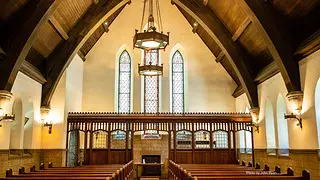
photo by: John Ryan, J&J Studios
Interior of the Church of Holy City in Wilmington, Delaware.
An open and affirming ministry of The Swedenborgian Church of North America, The Church of the Holy City prides itself on offering welcoming spaces for neighborhood pollinators.
“In our tradition, we have a deep respect for nature,” explained Reverend Shada Sullivan.
That respect for nature made the idea of planting native and insect-friendly plants attractive to the congregation when Sacred Grounds Wilmington, a collaborative program between the National Wildlife Federation and Delaware- and Wilmington-based organizations, was just starting.
Stay connected with us via email. Sign up today.
That program helps faith communities install wildlife habitats on their grounds. The Church of the Holy City was one of two pilot sites. The program has since expanded to over 20 sites citywide. “The program created an infrastructure for supporting congregations specifically on that journey towards creating an area of wildlife habitat,” said Sullivan.
The Church of the Holy City’s sun garden and two shade gardens dot the grounds around its nineteenth-century stone building, which had to be taken apart and reconstructed in the early twentieth century as Wilmington grew. The church received a grant from the National Fund for Sacred Places in 2024 to help replace degrading masonry and mitigate water infiltration that was endangering many of its stained-glass windows.
St Peter’s–San Pedro Episcopal Church (Salem, Massachusetts)
This Episcopal church in Salem has been serving locals for almost three centuries. Founded in 1733, its multicultural and bilingual congregation now gathers in a building dating to the early nineteenth century. A 2023 grant from the National Fund for Sacred Places will help the church fund needed repairs to its historic building.
Simultaneously, the church is undergoing retrofitting to make it more energy-efficient and, eventually, the central node in a neighborhood renewable energies network. “We are at once an historic site, a vibrant living church, and one that is trying to serve our community as a climate resilience hub and center of innovation and green technologies,” Reverend Nathan Ives said.
St Peter’s–San Pedro Episcopal Church’s ambitious Heaven and Earth project will use both solar and geothermal energy to serve as many as two dozen commercial, residential, and municipal buildings. It has already received over half a million dollars in grants. The church will serve as a climate resilience hub with uninterruptible green energy, making it a refuge where community members can shelter during climate emergencies.
“We feel very called to do this work, and at the same time, we’re an historic site,” Ives said. “So we are doing everything in a very subtle way, making it energy efficient without disturbing its historic nature.”
_mr.webp)
photo by: St. Peters/San Pedro Episcopal
Exterior view of St Peter’s–San Pedro Episcopal Church in Salem, Massachusetts.
St. Charles Avenue Baptist Church (New Orleans, Louisiana)
New Orleans is no stranger to extreme weather, and crumbling infrastructure and underfunded services have left major gaps in disaster response. "We can no longer rely on the power company to keep the lights on or the city to rapidly open up resilience hubs," said Becky Meriwether, a member of St. Charles Avenue Baptist Church and a delegate to Together New Orleans, a coalition of local organizations.
To prepare for the next disaster, places of worship across the city are being outfitted as “community lighthouses” with support from Together New Orleans. Among them is St. Charles, a congregation housed in an early twentieth-century Spanish Colonial Revival-style building. That historic building will soon be home to solar power and backup battery storage, making it a refuge and resilience hub. Eventually, it will be one of over 80 such hubs, ensuring that every New Orleans resident lives within a 15-minute walk of one.
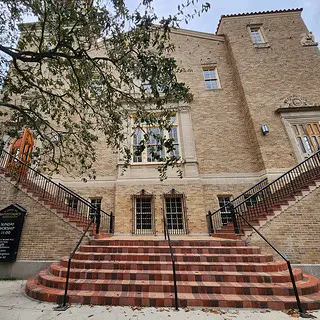
photo by: Marc J. Boswell
Exterior of the St. Charles Avenue Baptist Church in New Orleans, Louisiana.
"Places of worship have a calling to help people in need, and they also have traditionally served their neighborhoods," Meriwether said. "The congregations also serve as a reservoir of volunteer folk who come out and actually open these places up [after a storm]."
A 2019 grant from the National Fund for Sacred Places helped St. Charles's congregation preserve its space and prepare for extreme weather by funding repairs to the building's envelope, which were completed in 2024.
Christ on Capitol Hill (St. Paul, Minnesota)
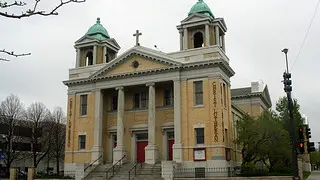
photo by: Katherine Scott, Black Box Images
Exterior of Christ on Capitol Hill in St. Paul, Minnesota.
Scandinavian immigrants first organized what would become Christ on Capitol Hill in St. Paul in 1868. The congregation moved into a Beaux-Arts style building in 1915, across the street from the Minnesota State Capitol. In 2024, the church received a grant from the National Fund for Sacred Places to support rehabilitation to prevent wall deterioration and improve safety and public access to its historic building.
Visitors, both human and insect, also come to Christ on Capitol Hill to enjoy its vibrant gardens, packed with native plants.
Congregation members Sharon Hardy and Roger Hardy, a couple who joined the church when they moved to Twin Cities about 15 years ago, care for the gardens. “We are both farm kids, so working with soil and gardening...is kind of in our blood,” Roger said.
It was Sharon, a master gardener, who decided to plant more native perennials. “We recognize that there are a lot of different species that are endangered, monarch butterflies being one of them, and we want to do our part to make our space more climate-friendly and make the world a better place,” she said.
The couple estimates there are now over 40 native plant species growing in the church gardens, including milkweed, where monarch butterflies lay their eggs each year.
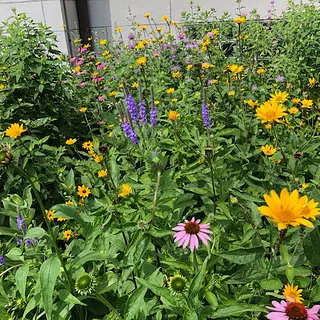
photo by: Sharon Hardy
Some of the native plants in the Christ on Capitol Hill gardens.
Save Historic Places That Tell Our Full American Story
When you join the National Trust, you help save historic and culturally significant places nationwide.