Chill Out with 5 Vintage Fans at Historic Sites
Today’s blistering summers have resulted in people around the world exploring new ways to keep cool. While air conditioning is now a common convenience, it hasn’t always been available—nor is it always guaranteed. And as reliance on air conditioning grows, so too does its toll on natural resources.
Curious as to how people in the past stayed cool before air conditioning, we asked staff at the National Trust’s Historic Sites and Historic Artists' Homes and Studios to share information about the vintage fans in their collections.
Read ahead to explore a selection of fans that are being preserved at historic sites around the country. For more inspiration, check out additional time-tested methods that provide relief from the summer heat.
Edith Farnsworth House (Plano, Illinois)
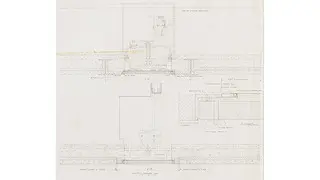
photo by: Edith Farnsworth House
A house fan was built in the Edith Farnsworth House to keep temperatures cool during the summer months.
While the Edith Farnsworth House does not technically have a vintage fan in its collection, the site itself includes a house fan. Located in the floor of the utility closet, the fan draws cool air into the house and exhausts warm air through the metal grille beneath the kitchen sink. When staying there, Edith Farnsworth would open the hopper windows in the sleeping area and the doors between the dining area and what was once the screened porch. She would then turn on the house fan to circulate cool air through the house. Later, in the 1990s, an air conditioning unit was installed.
Cliveden (Philadelphia, Pennsylvania)
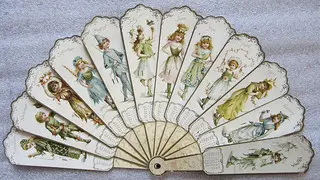
photo by: Cliveden
Some of the fans in Cliveden’s collection include hand-painted and printed decorations.
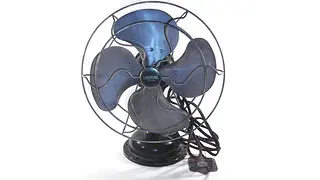
photo by: Cliveden
Cliveden's fan collection includes the Signal 450A, an electric, rotating table-top model.
In the eighteenth and nineteenth centuries, people used handheld fans to keep cool. Cliveden, which was occupied from the 1760s to the 1970s, houses a variety of fans from this period. They are made from paper, wood, feathers, ivory, and mother-of-pearl, and some are decorated with hand-painted and printed designs. The cardboard fan featured above dates to the nineteenth century and depicts children representing the twelve months of the year. Inventors like Schuyler Wheeler created models of electric fans in the 1880s, but they did not become widely available until the 1920s. By the mid-1900s, electric fans were commonplace.
Oatlands (Leesburg, Virginia)
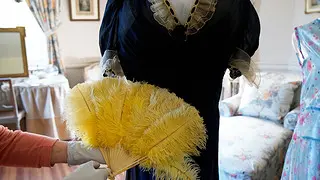
photo by: Oatlands
In addition to their practical use, handheld fans also functioned as fashionable accessories and popular giveaways at large events.
In addition to their practical use, handheld fans also functioned as fashionable, decorative accessories. The fan in Oatlands’ collection is stamped with the words “Bowman’s Harrisburg PA April 1919” on the front. On the back, the fan features the Rotary Club logo and the words “5th District Convention.” This fan was likely a promotional souvenir offered to convention attendees. Beginning in the 1700s, fans were used as commemorative objects. Guests at weddings, church gatherings, business events, and other large occasions were sometimes given handheld fans as gifts, as was likely the case with Oatlands’ feathery yellow fan.
Charles & Ray Eames Foundation (Pacific Palisades, California)
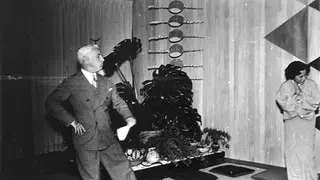
photo by: © 2026 Eames Office, LLC (All Rights Reserved)
Charlie Chaplin performed a dance with a fan gifted to Charles and Ray Eames at the tea ceremony they hosted for artist Isamu Noguchi and actress Yoshiko Yamaguchi (pictured at right) in 1951.
Handheld fans also had a moment at the Charles & Ray Eames Foundation, which was inducted to the Historic Artists' Homes and Studios program in May 2026. On July 24, 1951, designers Charles and Ray Eames hosted a traditional Japanese tea ceremony to celebrate the marriage of their friends, artist Isamu Noguchi and actress Yoshiko Yamaguchi, also known professionally as Shirley Yamaguchi. At the ceremony, guests were served tea on the LTR tables designed by the Eameses, and Noguchi’s Akari light sculptures illuminated the space. Charles and Ray Eames received handheld fans and yukatas—light, breathable cotton kimonos—as gifts from the tea master who led the ceremony. Actor Charlie Chaplin was among the guests present and is pictured above performing his own rendition of a traditional Nō dance with one of the handheld fans given to the Eameses.
Stay connected with us via email. Sign up today.
Wilson House (Washington, District of Columbia)
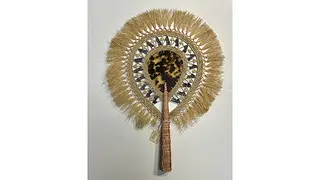
photo by: The Woodrow Wilson House
A Micronesian handheld fan from the Marshall Islands, likely acquired by Edith Wilson, is preserved in the Wilson House's collection.
The vintage fan in the Wilson House’s collection is from the Marshall Islands. Constructed from natural, locally sourced materials, it reflects traditional Micronesian design and craftsmanship. While the date of the fan is unknown, it was likely acquired by Edith Wilson, an avid traveler.
In 1919, the League of Nations granted the Empire of Japan control of Micronesia under the South Seas Mandate, formalizing Japanese administration after the islands had been occupied during World War I. This handheld fan reflects both Micronesian artistic tradition and the colonial trade networks that developed under Japanese rule, which resulted in Micronesian objects such as this being more widely available.
Save Historic Places That Tell Our Full American Story
When you join the National Trust, you help save historic and culturally significant places nationwide.