From Ship to Shore: 5 Facts About Traveling Trunks During the Golden Age of Travel
Duffel bags, backpacks, hard suitcases, garment bags.
We often optimize our luggage for travel based on the mode of transportation. Nowadays, to beat airline prices, we streamline everything into a carry-on, leaving our less curated baggage for road trips where we often have room to spare.
This wasn’t the case in the late 19th and early 20th centuries when, as carriages grew bigger and the steam ship came into vogue, the ideal traveling companion was a traveling trunk.
Adapted from a March 2026 program presented by Elizabeth Marriott, the collections and curatorial projects assistant at Kykuit, the Rockefeller estate at Pocantico Center, here are five facts about traveling trunks for you to unpack.

photo by: Kykuit
Katrina London, curator at Kykuit, introduces the program.
There are four primary types of traveling trunks.
During the so-called golden age of travel, there were four distinct popular luggage types. While domed trunks (c. 1830) were used as far back as the Renaissance, they came more in fashion as wealthy Victorians started traveling more. The shape of the trunk mattered: where the dome provided strength and easy water flow on a carriage, the later flat top trunks (c. 1860) were designed to be stacked on railcars and steam ships (a trunk was on average 50lbs when it was empty!)
The wardrobe trunk (c. 1900) starts showing up around 1900 and its main benefit was the different compartments and storage which made it easier to pack. However, like its predecessors, these trunks could weigh more than 100 lbs by the time they were loaded onto the train or ship. Consequently, by the turn of the century—in a trend that will sound familiar—weight-derived baggage handling fees started to increase. This led to the advent of the hardcase suitcase (c. 1915), which started as a more fragile option before Jesse Shwayder brought trunk manufacturing techniques to handheld luggage. Shwayder would later introduce the hard-shell vulcanized suitcases under the name Samsonite in the 1940s.
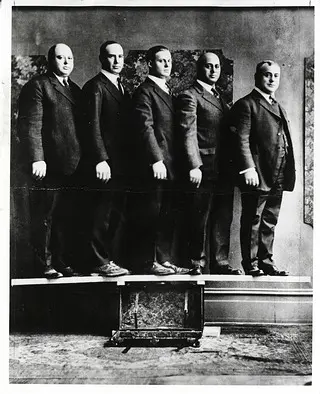
photo by: Denver University Libraries
Jesse, Mark, Maurice, Benjamin, and Solomon Shwayder illustrate the Shwayder Trunk Company slogan: “Strong Enough to Stand On.”
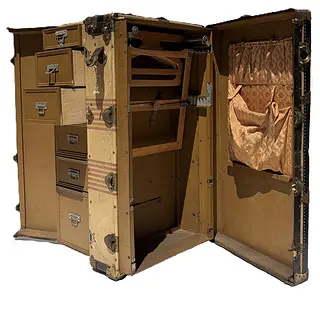
photo by: Kykuit
A ca. 1920 Oshkosh wardrobe trunk used by the Rockefeller family in Kykuit’s collection.
The company that made most trunk locks also made the door locks for the Chrysler Building.
In the early 1900s, larger trunks were assembled by hand using tradecraft from a century before. Often working in small basement workshops, trunk makers completed an average of 100 trunks per week using parts from other manufacturers.
The most common trunk lock was made by the Yale Lock Manufacturing Company (later Yale & Towne). Based in Stamford, Connecticut, they employed about 12,000 people in the United States, Canada, and England. While locks weren’t the only mode of keeping a trunk closed—even in this era, the curse of the overstuffed luggage existed—they were a key part of the closing mechanisms in addition to leather straps and reinforced clasps. For Yale, trunk locks were just a small part of their business; their work can also be seen at the Chrysler Building in New York City.
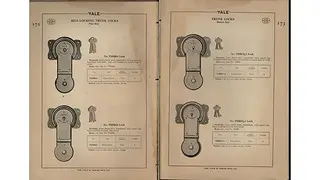
photo by: Internet Archive/Tulane University Southeastern Architectural Archive,
Trunk locks for sale in the 1929 Yale & Towne Manufacturing Company catalog.
Have Great Organization Skills? Be a Trunk Packer!
In the San Francisco Sunday Call in 1904, Adele Bruges—a professional luggage packer—said, “I went into trunk packing when I was 18 years old and I have been at it for three years […] My patrons are all rich women, and when you deal with the pampered darlings of fortune you have got your hands full. […] I work very quickly and I charge $1 an hour. I can usually manage to pack a trunk in an hour. If I am busy all day, I earn eight or ten dollars, and this is enough for any girl.”
During the early 1900s, it was difficult for rich families to retain household staff because the pay and schedule were better at large hotels. This void created opportunities for freelance professional packers like Bruges. The work was exacting and meticulous, requiring keen attention to detail, particularly for dresses that often cost thousands of dollars.

photo by: Kykuit
A ca. 1920 Oshkosh wardrobe trunk (left) displaying the interior hangers, drawers, and pouches; and a pre-1895 flat-top trunk (right) with ribbon envelope organizer on the lid, both in Kykuit’s collection.
We wouldn’t have luggage carts if not for NYC’s Penn Station.
So how does the luggage get from Point A (the traveler’s home) to Point B (the traveler’s destination)? Part of the competition between ocean liner and railway companies was a constant search for amenities. One important one was to make traveling with luggage as convenient as possible. By 1900, most companies collected bags directly from (mostly wealthy) travelers' homes the night before departure for a small fee.
The porters who moved all this luggage were paid low wages, often augmented by tips, despite being responsible for their own meals, uniforms, and supplies on shifts. Following the Civil War, George Pullman, who founded the Pullman Palace Car Company, started the practice of hiring newly freed Black men as baggage porters—and paid them far less than their white counterparts. The Pullman Porters and the Brotherhood of Sleeping Car Porters became integral to the fight for labor and civil rights.
And how did they move the luggage? While different inventors worked on the problem of moving luggage swiftly, it was at New York’s Penn Station where the first battery-operated vehicle was used. The Elwell-Parker Company developed the Electric Porter with a switch, a handbrake, and handles that moved from side to side.
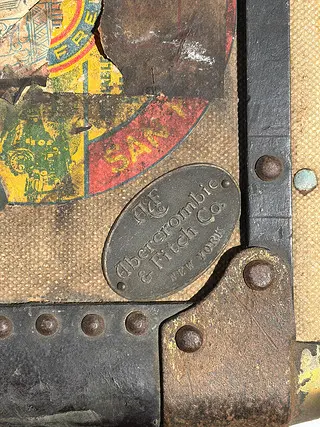
photo by: Kykuit
The Abercrombie & Fitch plate affixed to Kykuit’s ca. 1920 Oshkosh wardrobe trunk before the trunk was sold in A&F’s New York store.
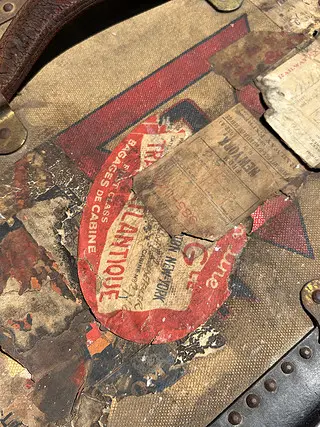
photo by: Kykuit
Shipping labels affixed to Kykuit’s ca. 1920 Oshkosh wardrobe trunk during Nelson Rockefeller’s travels.
Some of the first female federal employees were hired to spot smuggled luxury goods.
During this period, Customs inspectors were responsible for searching all luggage entering the United States as they tried to enforce the high import duties imposed on foreign goods by the Morrill Tariff Act in 1861.
This tariff benefited department stores. While they did import foreign luxury goods, the stores could still save by ordering large volumes, which allowed them to undercut smaller domestic sellers. To compete, many independent businesses resorted to smuggling: they traveled overseas to purchase goods that would face a duty and then sewed the items into clothing or hid them in trunks. Male customs inspectors were bad at spotting this type of smuggling, so in 1861, starting with the New York City Customs House, female “inspectresses” were hired to watch out for so-called “fashionable smuggling.”
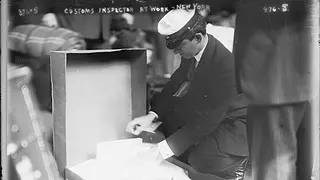
photo by: Bain News Service/Library of Congress
A customs inspector searches passenger luggage by hand before ocean liner passengers enter New York port.
One thing to note is that this search of travelers was unevenly enforced. Third-class and steerage passengers (particularly Jewish and Chinese immigrants) were often targeted in an attempt to justify immigration quotas in the early 1900s. Wealthy travelers could skirt the import fees through bribery.
Want to learn more? Watch the full presentation
Save Historic Places That Tell Our Full American Story
When you join the National Trust, you help save historic and culturally significant places nationwide.