Art in Dialogue: Tomashi Jackson and Robert Rauschenberg at The Glass House
The Glass House has always served as a nexus of creativity and artistic vision. Architect Philip Johnson designed the Modernist house, which was built in 1949, and additional structures on his expansive property in New Canaan, Connecticut. It was his weekend home, a place to display art, and a space for salon-style gatherings with his collaborators and friends. Now a National Trust Historic Site, The Glass House maintains that spirit by presenting works by contemporary artists in addition to pieces from Johnson’s collection.
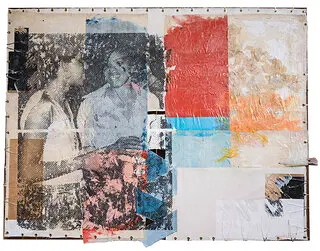
photo by: The Glass House/David Heald
Constant Craving by Tomashi Jackson.
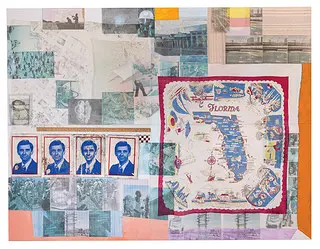
photo by: The Glass House/David Heald
Ringmaster (Spread) by Robert Rauschenberg.
Through December 14, Tomashi Jackson and Robert Rauschenberg: The Catch One pairs multiple works by the two artists, both known for combining paint with unusual materials such as fabric, photo transfers, and found objects. Last year, Jackson responded to Rauschenberg’s pieces in The Glass House’s collection during her residency at his home and studio in Captiva, Florida. Noting that Johnson’s house and the Captiva compound were sanctuaries created by white queer men, Jackson recalled her mother’s involvement with sanctuaries for Black queer women in her native L.A. Her piece Constant Craving includes a photo transfer of Jewel Thais Williams, owner of Jewel’s Catch One, a nightclub in L.A. that was a vital, welcoming space for queer and Black communities. The imposing piece—roughly 7 feet by 8 feet—includes wood that Jackson found in Captiva, along with fabric and paint.
Displayed facing Constant Craving is Rauschenberg’s similarly sized Ringmaster (Spread), from 1980. The piece contains found materials and photo transfers from magazines. An image of a perfectly coiffed white businessman and photo transfers that celebrate U.S. industry are juxtaposed with images of bloodshed and ruins in Uganda. Both artists “were interested in how art intersects with everyday life,” says Cole Akers, the curator at The Glass House. “These works contend with the many-layered histories that are present at this site.”