Game On: 8 Puzzles, Card Decks, and Board Games at Historic Sites
From paper card decks to wooden puzzles to clay marbles, games encapsulate many different objects and functions. At Cliveden, the Chew family's use of cards while entertaining illustrates the way some games catered to gatherings, while artist Reuben Hale's puzzles and brainteasers provided him with a solitary challenge. Other objects—like the poker chips discovered at the Hotel de Paris Museum—reflect the way people could use games to earn (or lose) additional income. In all cases, games provide a relatable glimpse into the daily lives of people who lived in the past.
To learn more about them, we asked staff at the National Trust Historic Sites and Historic Artists' Homes and Studios to share information about the game objects in their collections. Read on to explore a selection of games that are preserved at historic sites around the country.
Reuben Hale House and Sculpture Garden (West Palm Beach, Florida)
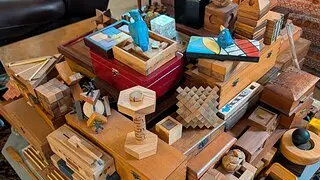
photo by: Irma Hale, The Reuben Hale House
Artist Reuben Hale's puzzle table is home to his lifelong collection of puzzles, carved figures, and handcrafted wooden boxes.
While artist Reuben Hale collected and worked on puzzles of every kind, he was especially drawn to three-dimensional ones. “For Reuben, three-dimensional puzzles held a particular appeal,” Irma Hale, Reuben Hale's daughter, shared. “They rewarded patience and spatial reasoning much like his artwork did.” Hale collected interlocking wooden burrs, sequential-movement boxes, and secret-opening containers that he gathered from makers around the world. In addition to Hale's puzzle collection, over the course of his life, the family's coffee table also became stacked with handcrafted wooden boxes and carved figures. Unsurprisingly, game nights were central to Hale family gatherings. According to Irma Hale, dominoes were a family favorite. “Reuben introduced dominoes to me when I was barely three,” she said, “tracing the dots with my fingers across the tiles and counting by fives was one of my earliest lessons in arithmetic.”
The Woodrow Wilson House (Washington, District of Columbia)
Former President Woodrow Wilson owned a deck of 52 playing cards. The deck—which was produced by British card makers Charles Goodall & Sons—features portraits of the British royal family. During his presidency, Wilson worked closely with the British government and other Allied leaders during World War I. In 1918, he traveled to England and met with members of the British royal family, including King George V and Queen Mary. In doing so, Wilson became the first sitting U.S. president to travel to Europe. This card deck, which dates to the early 1900s, reflects the popularity of illustrated playing cards during the nineteenth and twentieth centuries. Wilson kept these cards in his home, and in light of his close working relationship with the British government, they may indicate his own appreciation of English history and culture.
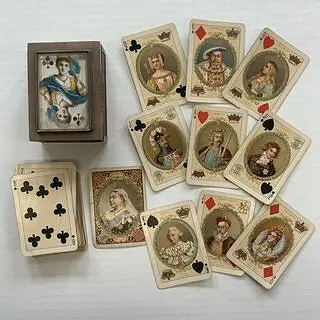
photo by: The Woodrow Wilson House
Former President Woodrow Wilson owned a pack of playing cards that feature portraits of the British royal family.
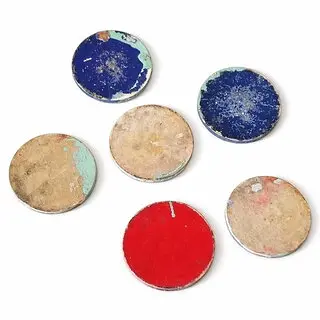
photo by: Hotel de Paris Museum
Handmade poker chips were found at the Hotel de Paris Museum, suggesting gambling activities may have once taken place at the site.
Hotel de Paris Museum (Georgetown, Colorado)
At the Hotel de Paris Museum, a collection of handmade poker chips was found in the former in-house laundry. The poker chips, which vary in value, are well-worn and suggest that private gambling activities may have taken place at the site. Museum staff are currently researching the poker chips in an effort to understand their origin and significance. Early findings suggest that they may be connected to John Touk, a Chinese American gardener and porter who was employed in the 1880s by proprietor Louis Dupuy. While the poker chip investigation is still underway, their discovery serves as a reminder that historic sites encompass a plethora of stories, many of which have yet to be uncovered.
Stay connected with us via email. Sign up today.
Pollock-Krasner House and Study Center (East Hampton, New York)
In 1948, commercial screen printer Sanford LeRoy Pollock McCoy—Jackson Pollock's brother—created Autograph Baseball Game, a board game for baseball fans. The game board was screen printed on pressed wood, and Pollock McCoy had many pre-cut boards left over after the game's production. He offered some of them to Jackson Pollock, who painted abstract compositions on sixteen of them, and used additional boards to cover the floor in his studio, under his painting storage racks, and in two upstairs rooms in the house. In 1987, when the Pollock-Krasner House was being readied to open as a museum, the game boards were removed from the studio floor and revealed evidence of Pollock's action painting technique. Today, these unique artifacts are central to the site's interpretive program.
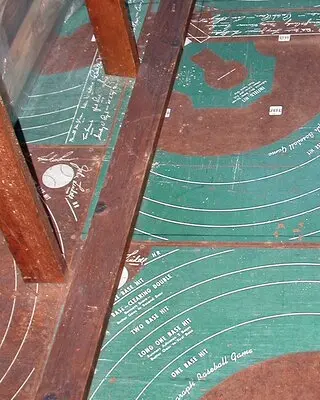
photo by: Pollock-Krasner House and Study Center
Artist Jackson Pollock used pre-cut game boards manufactured by his brother as floor tiles in his studio and house.
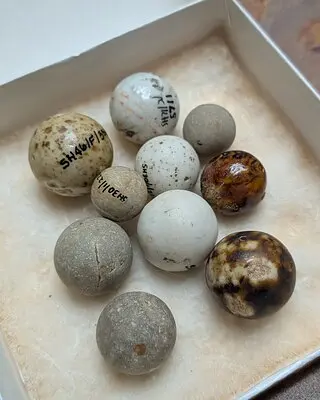
photo by: Shadows-on-the-Teche
A set of clay marbles was found at Shadows-on-the-Teche during an archaeological dig in the 1980s.
Shadows-on-the-Teche (New Iberia, Louisiana)
In the 1980s, a set of clay marbles was found at Shadows-on-the-Teche. Discovered during an archaeological dig, the clay marbles were located at the foundation of Louisa Bryant's cabin. Bryant, who was a housekeeper at The Shadows, shared the cabin with her eight children and husband, all of whom were enslaved by the Weeks family. The marbles are undated but may have been used by Bryant's children to play games. While details about the clay marbles are difficult to determine, they provide insight into what may have been a source of entertainment for the Bryant family, whose personal time and autonomy were extremely restricted due to their enslavement.
Eames House, Charles & Ray Eames Foundation (Pacific Palisades, California)
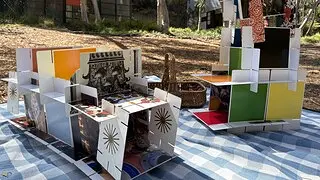
photo by: © 2026 Eames Office, LLC. All rights reserved.
Artists Charles and Ray Eames designed House of Cards, a game that uses pre-cut cards as building components to create structures.
In 1952, designers Charles and Ray Eames designed the game House of Cards. A deceptively simple game, it embodies their fascination with structure and play. Unlike a conventional card deck, these cards were intended to be built with, encouraging open-ended construction and architectural exploration. Each set consists of precision-cut cards with six slots along their edges so they can be joined together to form three-dimensional structures. The game is a reflection of the principles behind the Eames House itself, which was assembled from off-the-shelf industrial parts. The first edition of House of Cards contained 54 cards, each with a textured or colored pattern on its face. Later editions were printed with various images, including photographs taken around the Eames House and illustrations or graphic patterns from the Eameses work. Visitors to the Eames House today will likely see a deck assembled in the studio, or on a picnic blanket in the meadow.
The Glass House (New Canaan, Connecticut)
In The Glass House's collection are a series of puzzles that Philip Johnson gifted to his partner David Whitney as Valentine's Day gifts. These puzzles, which were custom orders made especially for Johnson, were created by the Stave Puzzle Company in Vermont. They were crafted from hand-cut wood and feature unique interlocking shapes. One of the puzzles Johnson ordered features Andy Warhol's 1966 artwork titled Self Portrait. In 1998, Johnson donated this painting to the Museum of Modern Art (MoMA). A major donor to the museum, Johnson donated over 2,000 other artworks to the collection, and served as MoMA's first curator of architecture and design. Today, this collection of puzzles can be found at The Glass House, where they illustrate the lifelong partnership between Johnson and Whitney.
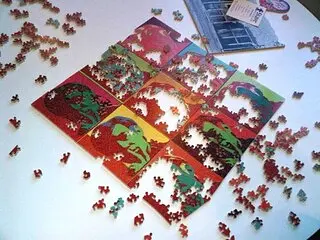
photo by: Kate Lichota, The Glass House
Architect Philip Johnson custom ordered puzzles, including one featuring Andy Warhol's artwork, as gifts for his partner David Whitney.
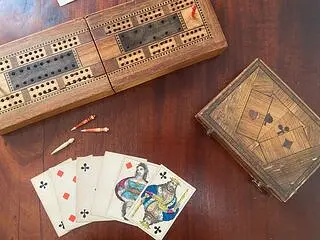
photo by: Cliveden
A cribbage board and two decks of playing cards in an inlaid box are in Cliveden's collection.
Cliveden (Philadelphia, Pennsylvania)
In 1768, Benjamin Chew—the first owner and resident of Cliveden—purchased playing cards for 12 shilling and 6 pence, a sum referenced in Chew's receipts for "1 Doz of playing Cards." Other members of the Chew family also reference playing cards, including Benjamin Chew Jr., who noted he "lost at cards" and paid 16 shillings and 10.5 pence in 1797 because of it. Nearly ten years prior, in 1786, Anne Hume Livingston wrote in her journal that, "Mrs. Allen & the Miss Chew's drank Tea with me & spent the evening." She continues, writing that they conversed "till nine when cards were proposed, & about ten, refreshments were introduced which concluded the Evening." Livingston does not specify which games were played, but popular games in the eighteenth century included whist, a trick-taking card game, and cribbage, a card game that involves players grouping cards together to gain points.
Save Historic Places That Tell Our Full American Story
When you join the National Trust, you help save historic and culturally significant places nationwide.