3 Lessons on Putting Resilience into Practice at Historic Places
A look back at one year of partnership with Travelers Across America.
Over the past year, Travelers Across America, a partnership between Travelers and the National Trust for Historic Preservation, has given us an opportunity to test practical approaches to resilience at historic places and bring together people from different fields to explore the challenges facing these sites and their communities.
With a $1 million investment from Travelers, the initiative supported resilience projects at four historic places across the country and convened preservationists, insurers, technical experts, government officials, and community leaders to share ideas and explore opportunities for collaboration.
Two questions guided our work from the beginning: How can different sectors work together to make historic places more resilient? And how can historic places themselves contribute to the resilience of their surrounding communities?
As we reflect on the first year of the partnership, three lessons stand out.
Preservation and resilience must work together.
Preparing historic places for climate risks can no longer be treated as an optional part of preservation. It needs to be central to how we steward these places and plan for their future.
Adapting historic buildings and landscapes presents particular challenges. How do we reduce risk while protecting the materials, character, and significance that make these places worth preserving?
Through Travelers Across America, we supported four projects addressing different risks and demonstrating different approaches.
At the Eames House in Los Angeles, wildfire resilience improvements included removing and pruning trees, improving irrigation, and replanting a vulnerable hillside with fire-resistant native species—all while respecting the character of this nationally significant landscape.

photo by: Seri Worden
Travelers Across America gathered at the Eames House in Los Angeles.
Stay connected with us via email. Sign up today.
At Oliver Kelley Farm in Minnesota, a new cedar-shingle roof incorporates increased fire resistance, improved moisture management, and gutters designed to handle heavier rainfall. The project demonstrates how traditional materials can be used alongside modern resilience strategies.
At Mystic Seaport Museum in Connecticut, Travelers’ funding supported new floating docks designed to better protect historic vessels from flooding and rising sea levels.
And in New Orleans, the Preservation Resource Center is using Travelers’ funding to help install stronger, FORTIFIED roofs on historic homes in low- and moderate-income neighborhoods.
Each project required a different approach, shaped by the site’s history, physical conditions, and climate risks. Together, they show that protecting historic character and adapting to changing conditions can go hand in hand.
Putting resilience into practice requires resources and partnerships.
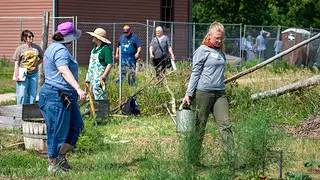
photo by: Travelers
Travelers employees spent a day of hands-on stewardship at Oliver Kelley Farm in Elk River, Minnesota, in August 2026.
Historic places face many of the same barriers as other properties: limited funding, technical challenges, and competing priorities. Historic buildings introduce additional considerations when improvements must be compatible with original materials and architectural character.
The Preservation Resource Center’s work in New Orleans brings several of these challenges together.
Through its Revival Grants Program, the Preservation Resource Center is combining Travelers’ funding with state resources to support the installation of approximately 15-20 FORTIFIED roofs on historic homes. The program is helping homeowners access improvements designed to reduce storm damage while maintaining the character of their neighborhoods.
Historic places can inspire collaboration and new ideas.

photo by: Mystic Seaport Museum
One of the ships at Mystic Seaport Museum in Connecticut, where participants gathered for the Travelers Across America Innovation Lab.
The gatherings at each of the four sites brought together people with different expertise and perspectives to explore the risks facing historic places and their surrounding communities.
In New Orleans, a gathering explored the connections among historic preservation, insurance, disaster mitigation, and neighborhood resilience.
In Los Angeles, we worked with the Getty Conservation Institute and other partners to convene a conversation about rebuilding more resiliently after the devastating January 2025 wildfires while protecting the places and character that define communities.
At Mystic Seaport Museum, more than 60 leaders and experts participated in an Innovation Lab focused on advancing resilience at historic sites and in their communities. And at Oliver Kelley Farm, approximately 80 Travelers employees participated in hands-on stewardship activities and learned about the skills and ongoing care required to maintain historic places.

photo by: Seri Worden
The initiative brought people together in New Orleans in November 2025.
What struck me about these experiences was how the historic places themselves shaped the conversations. Being on site, seeing the challenges firsthand, and understanding what’s at stake encouraged people to approach familiar problems from different perspectives.
As an insurance company with risk expertise, Travelers brought an important perspective to these discussions. Preservationists and insurers may approach many of these challenges differently, and the conversations helped reveal shared concerns and opportunities to work together. We also began to see connections between the risks facing individual historic places and those facing surrounding communities.
I came away from these gatherings with a greater appreciation for the power of historic places to bring people together, spark new ideas, and encourage collaboration around challenges that extend well beyond an individual site.
As we look ahead to the next phase of Travelers Across America, we’ll continue testing practical approaches to resilience, bringing different sectors together, and sharing what we learn to help more historic places and communities prepare for the future.
Save Historic Places That Tell Our Full American Story
When you join the National Trust, you help save historic and culturally significant places nationwide.