Preserving Legacies: Supporting Climate Adaptation for Global Heritage Sites
Climate change is one of the fastest growing threats to heritage sites and cultural practices worldwide. According to UNESCO, one in three natural heritage sites and one in six cultural heritage sites are already at risk. More than one in four of UNESCO’s designated sites could reach potentially irreversible tipping points by 2050. Alarmingly, these figures capture only a fraction of what is at stake. Risk to much of the world’s heritage, particularly Indigenous and community-held, remains untracked by formal frameworks.
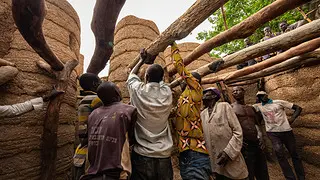
photo by: Michael O. Snyder, Preserving Legacies
Community members build a takienta in Koutammakou, the Land of the Batammariba, Benin & Togo.
The future of heritage in the face of climate change does not have to be one of loss and isolation. As heritage stewards, we can act now to safeguard the places and practices that make us who we are. And we don’t have to do it alone. Preserving Legacies is a global organization that offers free, action-driven training, tools, and global connections through its climate adaptation cohort program for heritage.
Individuals working with heritage sites may apply to join this three-year program through a competitive process, which opens each October for the following year’s cohort. Those selected receive tailored technical assistance and financial support as they learn about and assess climate risks, make adaptation plans, and take action to protect their sites and communities for generations to come.
Preserving Legacies: Join the Movement
The Power of Locally Led Climate Adaptation
The expertise of local communities to respond in the face of climate change is a resource for resilience.
Through Preserving Legacies, heritage stewards of all backgrounds are already collaborating with their local communities to co-create solutions. In Petra, Jordan, they are documenting and reinforcing ancient Nabatean terraces, helping to manage intensifying rainfall, flash floods, and drought. To protect the Maritime Landscape of Cartagena de Indias, Colombia, community members are replanting mangroves along the coast to help guard against flooding from sea level rise and storm surges.
-73%20(2).webp)
photo by: Michael O. Snyder, Preserving Legacies
Workers at Petra, Jordan reinforce ancient Nabatean terraces.
To help ensure adaptation is equitable and locally sustainable, Preserving Legacies’ three-stage framework—learn, assess, act—is rooted in a locally led, inclusive, and plural knowledge approach, where scientific, Indigenous, and local knowledge are woven together as equals.
.webp)
photo by: ICSM CHC GRAA, 2022
Illustration of Plural Knowledge. Adapted from the work of Dr. Sarah Forgesson, Preserving Legacies, adapted from her work.
Marlon M. Martin, head of a grassroots nonprofit and Preserving Legacies heritage steward for the Payo'n Binoltan - Ifugao Rice Terraces in the Philippines, highlighted the value of this approach when reflecting on the climate risk assessment workshop he led: “There were participants who were 70 to 90 years old also saying to listen to science and professors—but do not forget [the] teachings of your ancestors, there are things we know more than anyone else because we are here, we live here, we experience everything.”
.webp)
photo by: Convergence
Marlon M. Martin, a Preserving Legacies heritage steward, sets out to survey damage after a landslide at the Payo'n Binoltan-Ifugao Rice Terraces.
This holistic foundation upon which to assess risk and build adaptation action not only safeguards heritage sites and cultural practices in a way that is true to local conditions, culture, and expertise, it also strengthens the resilience of the communities connected to them.
How One Site is Paving the Way for Locally Led Climate Adaptation
In Brownsville, one of Miami’s earliest Black suburbs, the Historic Hampton House stands as a landmark of the Civil Rights era and an anchor institution for its community. The former Green Book hotel welcomed artists, athletes, activists, and travelers during segregation, including icons like Martin Luther King Jr., Muhammad Ali, and Ella Fitzgerald. Today, it carries forward that legacy of gathering, cultural expression, and social justice as it faces a new challenge: climate change.
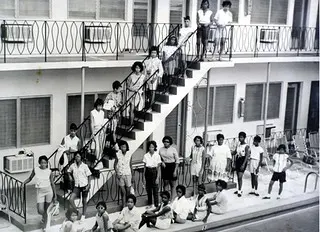
photo by: Patrick Ceres
Historic image of the Historic Hampton House, a Green Book site.
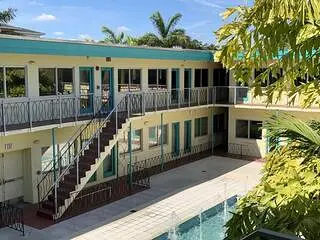
photo by: Patrick Ceres
A present-day photo of the Historic Hampton House.
Rising temperatures, more frequent and extreme storms, sea level rise, and flooding are creating new challenges for life across Miami-Dade County. In Brownsville, the impacts are compounded by a pattern of systemic disinvestment and discrimination that creates disproportionate climate exposure and risk.
For example, mature trees in Brownsville were removed to widen roads and build the Tri-Rail commuter line. This reduced the area tree canopy to 13 percent, which is less than half the recommended 30 percent coverage. Fewer trees mean hotter temperatures, which can be detrimental to community health and well-being.
Stay connected with us via email. Sign up today.
“The major climate hazard in Brownsville and of course, the Historic Hampton House is the heat. The heat, because the trees are gone, is sweltering,” said heritage steward and community advocate Jacqui Colyer, who is participating in the Preserving Legacies cohort program for the Historic Hampton House.
The heat strains community health and household budgets, as residents run air conditioners longer to cope. For the Historic Hampton House itself, sustained high temperatures increase the thermal expansion of building materials impacting its mid-century masonry, as well as increase temperature differentials between outside and inside that impact moisture movement. It also strains cooling systems, and puts the health and safety of visitors, staff, and community members who gather there at risk.
Fewer trees also means drier soil, which worsens flooding. “You'll see puddling in the front of the Historic Hampton House, of water that was never there,” Colyer said. Over time, this runoff can damage foundations and put irreplaceable archival materials at risk.
Getting ahead of intensifying climate impacts like these is imperative to community resilience. Colyer recognized this, applied to the Preserving Legacies cohort program in 2025, and was one of 11 sites selected.
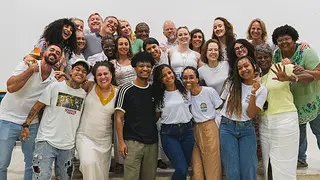
photo by: Elizabeth Carpio, Preserving Legacies
Jacqui Colyer (lower right) with Preserving Legacies heritage stewards from around the world at a local climate risk assessment workshop in Bahia, Brazil.
“To be a part of it just made me feel so hopeful and so happy because it meant that there's an organization out there looking at and knowing that we need help,” Colyer said. “We're just trying to figure this out, and it's hard to figure it out on your own, by yourself. But when you’ve got partners all over the world [such as from] Tunisia, Brazil, the United States, you know there are other places besides you.”
Colyer and the Historic Hampton House team are now deep in community and stakeholder engagement, weighing adaptation actions that include planting more trees, improving drainage, resilient restoration, and equitable investment initiatives. “They are ready to rise to the challenge,” Colyer shared of the Brownsville community, “building resilience by carrying on the Historic Hampton House’s legacy from social justice to climate justice.”
How to Get Involved
No matter the type, scale, or resources of the heritage you steward, Preserving Legacies and its newly launched Heritage Adapts! community of action can provide resources and assistance.
-546.webp)
photo by: Michael O. Snyder, Preserving Legacies
Preserving Legacies team and cohort participants travel to Cartagena de Indias, Colombia to learn from their climate risk assessment and adaptation workshop.
Preserving Legacies: About Us & Our Cohort Program
Every October, Preserving Legacies opens applications for its hands-on cohort program for adapting heritage to climate change. Each year, it can only accept eight to 12 heritage places and practices. Two local stewards from each site must be able to commit to a three-year program based on a three-stage approach:
- Learn: Begin a free training program rooted in a plural knowledge approach to enhance your skills in climate science, risk assessment, and adaptation strategies through online modules, virtual discussions, mentorship, and a fully funded international workshop that brings participants together for hands-on learning and exchange.
- Assess: Co-create a climate risk and adaptation assessment with local stakeholders and community members, with access to expert support, downscaled climate data, and funding.
- Act: Design and implement an adaptation action tailored to your community’s needs and culture, supported by a seed grant, targeted training, and access to partner networks to help bring your vision to life.
Heritage Now! Implementing Heritage Informed Decarbonization Policies (Forum Webinar)
The third in a three-part webinar series focusing on Heritage Now! featured Andrew Potts who spoke about Preserving Legacies/Heritage Adapts! (Timestamp: 1:05)
To reach even more heritage sites and cultural practices, Preserving Legacies spearheaded a coalition of over 100 organizations to launch Heritage Adapts!, a free online platform offering a self-paced version of its cohort program, including access to its Regional Climate Data Hub for localized data, resource library, and community social network. This adaptation initiative complements Heritage Now!—a parallel global campaign focused on climate mitigation through reuse, retrofitting, and support for traditional low-carbon heritage practices, and which hosts a discussion board for these topics on the Heritage Adapts! platform.
With the Super El Niño already reshaping 2026-27, the time to act is now. With the goal of supporting at least 3,000 heritage sites and cultural practices in taking locally led adaptation action by 2030, you can join Heritage Adapts! as a heritage steward alongside others actively adapting, or as a contributor or partner to share your expertise, connect with others, and support the broader mission.
Heritage Adapts! - A Letter from Heritage
Save Historic Places That Tell Our Full American Story
When you join the National Trust, you help save historic and culturally significant places nationwide.
.webp)

_mr.webp)