Furnishing a Dream: A Star Woodworker’s Handmade Home and Studio Unlocks Visitors' Creative Side
In a lemon grove 40 miles east of Los Angeles, woodworker Sam Maloof and artist Alfreda Maloof began hand-building their home and workshop in the 1950s. Over the next four decades, they expanded it into a magical haven for the arts. And then the state of California wanted to build a freeway through it.
In an unprecedented deal, state and local agencies spent an undisclosed amount of money in the early 2000s to relocate the buildings, build a new house for Sam and Alfreda, and create a $3.1 million endowment for a foundation. In return, the freeway’s construction proceeded and the original house became a museum, the basis for the Sam and Alfreda Maloof Foundation for Arts and Crafts (“the Maloof” for short), in Rancho Cucamonga, California.
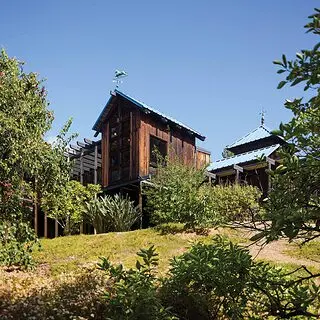
This year, the Maloof celebrates the 25th anniversary of its historic 2001 move. Now located nearly 3 miles from its original location, the compound continues to be a vibrant sanctuary for beautiful things: It’s part historic home, part furniture-making studio, part botanical garden, and part maker space. With a new executive director at the helm, the organization is broadening its reach even further, championing the handmade at a time when human endeavors are swamped by technology.
“I think as people are getting tired of the digital spaces and the threat of AI, there’s just something about using your hands,” says Drew Oberjuerge, who became the Maloof’s executive director at the end of 2025. “This house shows a lifetime of intentional living based on your creative values—it’s a life well-lived, with strong relationships.”
The Maloofs were a power couple in the American studio craft movement. Alfreda served as the director of fine and applied arts for the Santa Fe Indian School and helped sustain Native American artistic traditions while pursuing her own work in ceramics, painting, and textiles.
After they married in 1948, Alfreda gave Sam, a graphic designer by training, the resolve to pursue their livelihood as furniture makers. She managed the business side, and he “rose to prominence over the next four decades as perhaps the greatest living American woodworker,” states a 1999 Historic American Buildings Survey report.
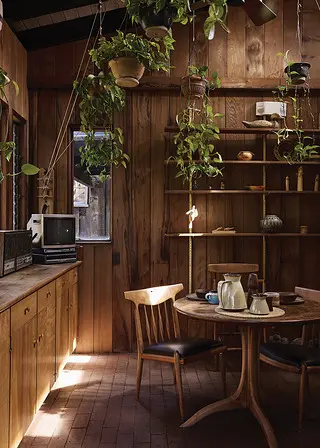
photo by: Joe Schmelzer
The kitchen nook includes Sam and Alfreda’s TV.
In 2001, the Smithsonian held a major retrospective of Sam’s distinctive furniture, which is collected by museums including the Metropolitan Museum of Art. His most iconic piece, a rocking chair, has an auction record of $80,500. He was self-taught and used power tools in an unconventional way, to the occasional detriment of his fingertips. Known for their exposed joints, his pieces reveal how they were put together.
“When I first started, I thought, ‘What a shame to cover something that is so beautiful,’” said Sam about joinery in the 1983 documentary Handmade in America: Sam Maloof. He would go on to develop the Maloof Joint, a unique locking joint that has entered the woodworking canon. Treasuring wood’s natural hues, he never stained his pieces and instead finished them with a custom formula of oil and varnish. In 1985, he became the first designer and woodworker to receive a MacArthur Foundation fellowship. The Maloofs turned down a lucrative opportunity to design a line of furniture for Knoll, valuing their way of life over money.
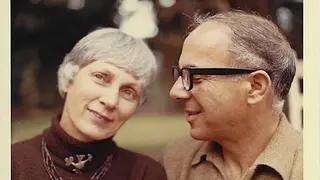
photo by: Sam and Alfreda Maloof Foundation for Arts and Crafts
Sam and Alfreda Maloof were married for 50 years and had two children.
“The importance of what Sam was doing was clear to me, and conserving the place was a way to provide the space for that to happen,” says Lindell Marsh, a land-use attorney who represented the Maloofs during their decade-long negotiations with the state. “I’m sitting right now on a chair at a dining table that Sam made. You can see that when they built the table, they cared about the whole thing. It’s not just a tabletop with a base; the whole thing is one smooth sculpture and has a wonderful sense of togetherness.”
“This house shows a lifetime of intentional living based on your creative values—it’s a life well-lived, with strong relationships.”
Drew Oberjuerge
After I go on a house tour at the Maloof, I get it. The home is an immersive environment where just about everything has been handcrafted. It’s not just the furniture that is interesting and expressive—the building itself is a giant woodworking project.
As the Maloofs’ finances allowed, they refined and expanded the original 800-square-foot house into a compound of nearly 10,000 square feet. Sam seized upon utilitarian elements as chances to create something special; one of his major influences was the Pennsylvania-based artist Wharton Esherick, who inspired him to craft wooden door hinges and latches, as well as a show-stopping spiral staircase. Philosophically and aesthetically, the home is tied into the Arts and Crafts movement, which originated in late 19th-century England in reaction to the mass production of the Industrial Revolution.
To an extent, the docent encourages me and the other visitors to touch the furniture, which is what Sam wanted. “Sam would be horrified if you used a placemat on one of his tables,” says artist Larry White, who started working for Sam in 1962 as his first paid studio assistant. “He would rather see it all marked up with water spots and really well used than to be pristine and beautiful.” In addition to all the studio furniture, the house is stuffed with the Maloofs’ art collection. After a while, the non-handcrafted parts of the house, like the plain white walls made from drywall, start to look wrong to me.
At the end of the tour, we are invited to sit on a high-back Maloof chair. I am surprised at how soft it feels. Even though it has no cushions or upholstery, its sculpted curves embrace me gently, rather than forcing my body to adapt to it. “I’m not too familiar about design, but I was able to appreciate the pieces,” says Michelle Ambrosio, another visitor on the tour. “I’ll never see a chair the same way again.”
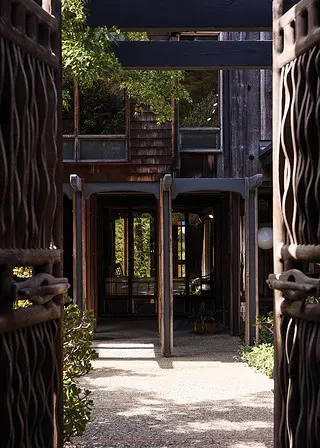
photo by: Joe Schmelzer
The inner courtyard at the Maloof.
“Many people think you only learn about art or see art if you go to a museum. So experiencing an environment that an artist has created is the freshening up of art history,” says art historian Wanda Corn. Corn is an advisor to the National Trust program Historic Artists’ Homes and Studios, of which the Maloof is a member. “One of the things that is really special about the Maloof is the comprehensiveness of the experience. You have this extraordinary domestic environment, you have a workshop that is still operating as a studio space, and you can get hands-on instruction. It’s not set in amber at all.”
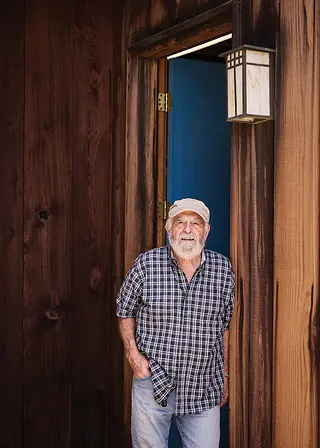
photo by: Joe Schmelzer
Larry White, a longtime Maloof associate, is the site’s artist in residence.
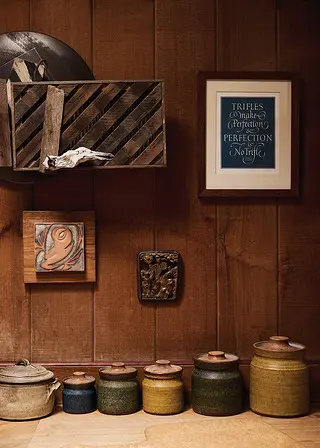
photo by: Joe Schmelzer
A tile by Alfreda (at left in photo) and an assemblage by Larry White above it.
The Maloofs were known for their hospitality and regularly opened their home for social events and gatherings. The site’s 5.5-acre grounds are open to the public, with no admission required. There is a charge for house tours, but otherwise the center functions more like a park when it is open: It welcomes people to bring picnics and hang out in the courtyard and the gardens, and there is free live music most Saturday afternoons. “I came here with a friend, and of course I fell in love with the nature and the flowers,” says artist Navai Toly. “I can sit here for hours just enjoying the nature.”
Stay connected with us via email. Sign up today.
Transplanting this place was a monumental effort. The Maloof is known in historic preservation circles as a Section 106 success story, referring to the section of the National Historic Preservation Act of 1966 that requires federal agencies to assess the impact of its actions on historic properties. In this case, the 210 Freeway extension was partially funded by the federal government, triggering Section 106 consultations with key stakeholders, including the Maloofs, the state historic preservation office, and the federal Advisory Council on Historic Preservation.
Unsurprisingly, Caltrans—the state transportation agency—and the San Bernadino Associated Governments (SANBAG), which was the local organization in charge of the freeway project, were not thrilled about the extra effort and expenditure required to mitigate the project's adverse impact on the historic property. “They did this kicking and screaming,” says architect Ann Kovara, the construction manager for the relocation and the author of the book Moving Sam Maloof (Schiffer Craft, 2016).
Fortunately, the Maloofs’ team included Marsh as well as Knox Mellon, who had previously served as California’s state historic preservation officer. In 1990, the Maloof compound was deemed eligible for listing on the National Register even though it didn’t fit the usual criteria: Sam was still alive, and the property wasn’t over 50 years old. “Sam Maloof, his career, impressively consistent body of work and pure esthetic, and the key relationship all of this has to the environment in which he worked and continues to work, met the exception threshold like few other properties ever have,” reads the Historic American Buildings Survey report.
One of the big questions to resolve was how to replace Sam and Alfreda’s unique home. As part of the agreement with the state, they would have to move into a new house on the new property so their original house could be used as a museum. “The architects had completed all the working drawings [for the new house] and were going to have a final meeting with Sam,” recalls Larry White. “I could see that he was really agitated. Finally, he just went off like Vesuvius and said, ‘I hate this! This is not what I told you I wanted. I can build a model and show you what I want.’ To this day, I cannot believe that Gary Moon, SANBAG’s project director, acquiesced. But they restarted the whole process and designed the building off the model that I built. And that set the whole freeway project back.”
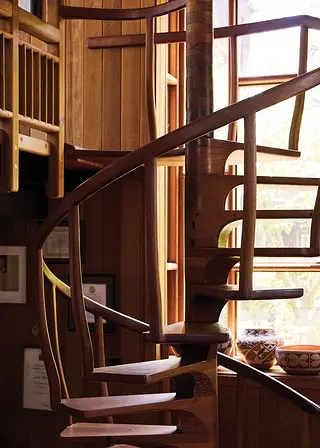
photo by: Joe Schmelzer
Sam Maloof’s sculptural spiral stair.
Before the new house could be constructed, Alfreda died at age 86. Sam made the move alone when he was 85. He married again, and his second wife, Beverly, created the Maloof’s current garden of native, Mediterranean, and drought-tolerant plants. As was his practice, Sam kept expanding the complex, initiating a standalone gallery and an archives building.
“From 2001 to his death in 2009, he kept adding. He never stopped imagining what the site could be for the community,” says preservation consultant Robert Chattel, who prepared the Maloof’s 2010 National Register nomination and believes the site is worthy of National Historic Landmark designation. Sam Maloof Woodworker, a business owned by one of Sam’s former employees, continues to build and sell his designs. Since Beverly’s recent death, the 4,500-square-foot “new” residence now belongs to the foundation, and the board plans to use the extra space for more workshops, gatherings, and events.
“I am very inspired being here. Art offers a fresh perspective to education.”
Ava Blanco
Like the original house, the Maloof’s workshop offerings have grown organically over the years. Nearly every weekend, community members have the chance to cultivate their artistic talents not only in woodworking, but also by learning skills that have included crocheting bead necklaces, linocut printmaking, and henna painting. White, the Maloof’s artist in residence, started by giving craft-focused tours, then demonstration classes on how Maloof furniture was made.
When people clamored for hands-on instruction, he began offering furniture-making workshops, which sell out almost immediately. He currently teaches people how to make a pre-set design, but he wants to empower them to do more. “I’m introducing a one-day design workshop where we talk about how a design develops from an idea to a drawing, and from the drawing into templates—the process of turning an idea into a thing,” says White, who turns 84 this year.
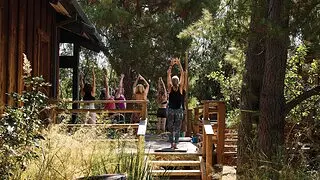
photo by: Joe Schmelzer
A Friday morning yoga class on the deck of the “new” house at the Maloof.
In her previous role as executive director at Riverside Art Museum, Drew Oberjuerge was responsible for turning an idea into the first-of-its-kind Cheech Marin Center for Chicano Art & Culture (also known as “The Cheech”). A native of California’s Inland Empire area, she is passionate about creating high-quality art venues for this vast region, which receives considerably less arts funding per capita than the state average.
“Here’s Sam Maloof, a local guy who was born in Chino, to Lebanese American immigrants. And he became an international rock star in the woodworking world,” says Oberjuerge. “I don’t think that people realize what’s here. So part of what we’ve been doing is just really trying to raise the profile of what’s available.”
To get to the Maloof, you drive up a road that goes straight toward the San Gabriel Mountains until you can’t go much further. Tucked away in a residential area, the property has minimal, discreet signage. It’s still a hidden gem, as it was in its original location, when lush plantings and lemon trees surrounded it.
On a Saturday in June, Oberjuerge is in the Jacobs Center Gallery, warmly welcoming visitors to the inaugural exhibition of members’ work, one of her initiatives. She hands the mic over to longtime volunteer and current board member Tom Bostick. “It’s activities like this that give us meaning and a reason to exist,” he says. Among the 60-odd works on display is a wood composition by Lauren Verdugo, a former apprentice of White’s and a rising star in the studio furniture and craft world.
There’s also a self-portrait by Paul Basenberg, an artist and local high school art teacher. Basenberg painted it in 2014 after he was diagnosed with brain cancer, which he died of a few years later at age 41.
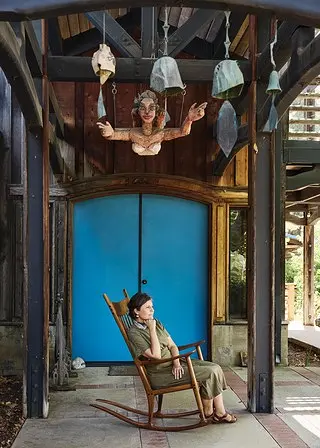
photo by: Joe Schmelzer
The Maloof’s executive director, Drew Oberjuerge, relaxes in a Sam Maloof rocker in the entryway.
“The Maloof was his second home,” says Mary Hanks, Basenberg’s mother, who wipes away a tear as she looks at the portrait. “He loved all kinds of art, and he loved it here because it was so eclectic. His dream was to be a volunteer docent here after retirement.”
Oberjuerge is also bringing more young people to the Maloof. To complement the existing free, monthly “Make and Take” family events, she added family friendly First Sundays, with activities for parents and children. She’s launched spring break and summer camps where kids can learn woodworking basics and safety, bookbinding, embroidery, and other crafts.
One of the camp’s instructors, Ava Blanco, got to know the organization as a Maloof Teen, participating (as did Lauren Verdugo) in a program for high school students that launched in 2010. “I am very inspired being here,” says Blanco, who is now in college studying to be an English teacher and works part-time helping ESL students and students with learning disabilities. “Art offers a fresh perspective to education. It’s about what the student is trying to express, about problem-solving and building on the strengths that are already there, rather than simply teaching what is prescribed. I see the potential to do more as an educator.”
“You have this extraordinary domestic environment … It’s not set in amber at all.”
Wanda Corn
I have my own chance to get a fresh perspective. I take a workshop on nuno-saiga, a Japanese art form that involves “painting” with pieces of fabric. Five of us gather in the “new” house’s spacious kitchen, which has a vaulted ceiling with massive wood trusses.
The teacher, fabric artist Sumi Foley, has brought a colorful assortment from her fabric collection for us to use, including intricately patterned scraps of old kimonos. I re-create the visitor map of the Maloof, which helps me realize how complicated Sam and Alfreda’s original house is when I have to cut out its floor plan. The student next to me is gluing down tiny pieces of striped fabric to form the feathers of an owl. The process is mesmerizing, and all of us work right through the lunch break of the four-hour workshop.
At the beginning of the workshop, a volunteer asks Foley, “Is it OK if I come in and take pictures of the work of the artists?” I wonder who she is talking about, and then I realize that she is talking about us, the workshop participants. For a few hours, in the handcrafted environment that Sam and Alfreda and Beverly created, surrounded by people who love art, I, too, am an artist.
Save Historic Places That Tell Our Full American Story
When you join the National Trust, you help save historic and culturally significant places nationwide.
In 2023, the Maloof received a Dorothy C. Radgowski Learning Through Women’s Achievement in the Arts grant through the National Trust’s Historic Artists’ Homes and Studios program and Where Women Made History initiative. The site used the funding to elevate Alfreda Maloof through new research, docent trainings and tours, and school lesson plans rooted in her life and work.