Moments of Play: Six Stories of Toys at Historic Sites
In 1995, Pixar released the first Toy Story movie, forever connecting a generation of adults and children to Woody, Buzz Lightyear, Rex, Slinky, Mr. Potato Head, Bo Peep, and Hamm. Told from the perspective of the toys, the film shared a message of connection, joy, and growing up—tackling complicated themes along the way.
As the film depicts, toys were meant for entertainment but throughout history they also shaped socialization skills, good behavior, and creativity. They could range from expensive mass-market toys to handmade toys made out of household items. And as certain toys went in and out of fashion, they became collectible for adults drawn back by nostalgia.
Here are six toy "stories" from National Trust Historic Sites and sites that are part of the National Trust’s Historic Artists’ Homes and Studios program. Each shows the different roles toys play in building connection and joy.
Doll Parts from the South Yard & “Lost” Noah’s Arc Wooden Animal Toys from the Gilmore Cabin | Montpelier (Orange, Virginia)
Doll Parts from the South Yard
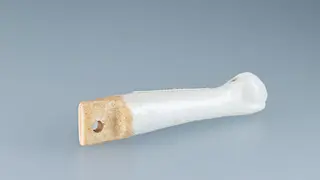
photo by: Montpelier/Gene Runion
During an excavation at Montpelier's South Yard a few different fragments of porcelain were found including this doll’s arm.
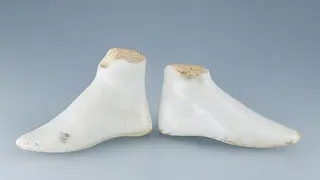
photo by: Montpelier/Gene Runion
These two porcelain feet were also found by archaeologists in the South Yard at Montpelier.
Excavations in the South Yard—a group of buildings at Montpelier that housed some of James Madison’s enslaved domestic servants—revealed many examples of toys, the most intriguing being a doll's foot and arm. Porcelain dolls like this were sometimes given to enslaved children as gifts, or once broken, handed down. Despite severe material limitations, enslaved children also created toys from discarded and organic materials (such as corn husk dolls and rag dolls), carving out space for play and imagination.
Play and wonder are fundamental to childhood development, and the ingenuity these children demonstrated in creating moments of joy under oppressive conditions is a pattern we see across the African diaspora and in many communities enduring trauma. Children form meaningful attachments to all kinds of toys, including those that are worn or broken, or even lost.
Wooden Animal Toys from the Gilmore Cabin (circa 1873-1920)

photo by: Montpelier
One of a few different wooden toys found in the clay daub near at the Gilmore Cabin at Montpelier.
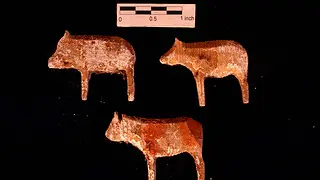
photo by: Montpelier
Archaeologists at Montpelier found these wooden figures between the logs near the front door of the Gilmore Cabin.
During the renovations to the Gilmore Cabin—once owned by a formerly enslaved man, George Gilmore—in 2000, three carved wooden toys were located in the clay daub between the logs at floor level near the front door. These wooden animals likely fell between the beams during play or possibly placed there by the Gilmore children or grandchildren. The presence of this set suggests during freedom, the Gilmores took the opportunity to give their children commercially available toys, allowing them to express their values and interests.
Human experiences are never one dimensional, and these artifacts offer a compelling and honorable story that gives agency and humanity to the children who played with them.
Montpelier is a National Trust Historic Site.
Zuni Beaded Dolls c.1940 | Couse-Sharp Historic Site (Taos, New Mexico)
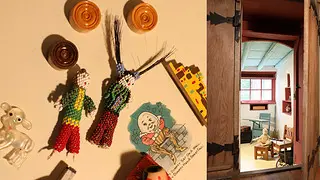
photo by: Lucas McDaniel
Two Zuni beaded dolls (left) collected by E. I. Couse’s grandchildren during their travels across the Southwest and the hidden entrance to their playroom (right) in this composite image.
The Couse-Sharp Historic Site is the home of Toas Society of Artists co-founder E. I. Couse (1866-1936). It also includes the studio of TSA artist, J. H. Sharp (1859-1953). After Couse’s wife passed away in 1929, his son, Kibbey, moved his family from New York to Taos so that he could care for his father. Needing additional space, Kibbey built an addition in 1930 that included a hidden playroom for his daughter Elizabeth, space later cherished by younger siblings Virginia and Irving as well.
These particular Zuni beaded dolls began appearing in the early 20th century as colorful souvenirs or “good luck” charms for tourists. The artform later evolved into more complex, free standing figures. The Couse grandchildren traveled throughout the Southwest in the years before WWII and it is believed these dolls were acquired during one of those trips.
The Couse-Sharp Historic Site is a member of the Historic Artists' Homes and Studios program.
Ferdinand the Bull, ca. 1938 | Florence Griswold Museum (Old Lyme, Connecticut)
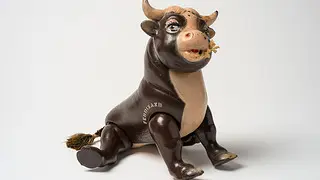
photo by: Florence Griswold Museum.
A figure of Ferdinand the Bull from the Florence Griswold Museum. Ideal Novelty & Toy Company, New York, New York Plastic, fiber, paint Gift of Mrs. Woodward H. Griswold 1968.236.
Within the Florence Griswold Museum’s modest collection of antique toys and amusements, Ferdinand the Bull is an audience favorite. The bull is the main character in Monroe Leaf's The Story of Ferdinand (1936), illustrated by Robert Lawson. The children's book tells the tale of a peaceful Spanish bull who prefers to sit and smell flowers rather than to fight with other bulls. When Ferdinand is stung by a bee (stenciled on the toy's back), his bucking and snorting result in him being sent to the bull fights in Madrid. Enchanted by the arena's sights and smells, Ferdinand sits calmly rather than battle the matador and is sent back to his pasture.
Published in 1936, the book's tale of nonviolence was widely understood as a response to the growing tide of fascism because of the story’s setting in Spain, where fascist Nationalist forces clashed with the leftist Republic in the Spanish Civil War. Two years later, Walt Disney adapted the text into the animated Ferdinand the Bull and produced this toy for fans of the Academy-Award winning film. Labelled with Ferdinand’s name as well as the Walt Disney Company copyright, the toy represents the way corporations like Disney successfully tied games and amusements to visual entertainment to create promotional juggernauts. A new generation was introduced to the gentle bull in the 2017 movie Ferdinand.
The Florence Griswold Museum is a member of the Historic Artists' Homes and Studios program.
Overland Circus Bandwagon, ca. 1920 | Villa Finale (San Antonio, Texas)
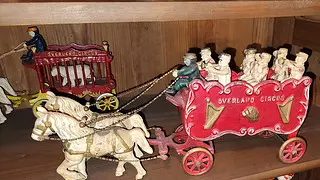
photo by: Villa Finale
One of the many circus toys that are a part of the collection at Villa Finale, a National Trust Historic Site.
Villa Finale has over 120 circus toys in its collection. Part of a much larger collection, the circus pieces were given to Walter Mathis—civic leader and historic preservationist who was the last owner of Villa Finale—by two of his brokerage clients, while the rest were donated to the Hertzberg Circus Collection and Museum (now closed), owned by the San Antonio Public Library.
One of the pieces in Villa Finale’s set is this cast iron Overland Circus bandwagon manufactured by Kenton Hardware Company of Ohio, ca. 1920. Part of a larger circus set that included animals in cages, wagons, and a calliope, these hardy toys were manufactured by Kenton from the 1920s through the 1930s and are highly collectible due to their authenticity and attention to detail. The company also produced the highly popular Gene Autry cap pistol in 1938. Kenton manufactured toys from1890 until it closed in 1952.
Villa Finale is a National Trust Historic Site.
Kewpie Dolls | Woodrow Wilson House (Washington, D.C.)
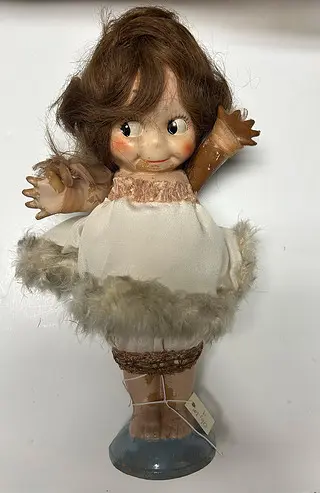
photo by: Wilson House
One of the Kewpie dolls, designed by cartoonist Rose O’Neill, at the Woodrow Wilson House.
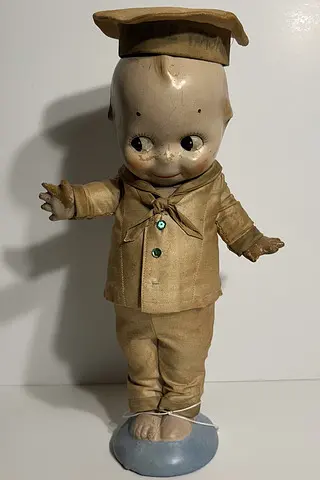
photo by: Wilson House
One of the Kewpie dolls, this one dressed as a sailor, at the Woodrow Wilson House.
Kewpie dolls, first created in 1909 by cartoonist Rose O’Neill, were among the most popular toys of the early twentieth century. Inspired by her illustrations, these figures are recognized by their round, cherubic faces and playful expressions; the name “Kewpie” is derived from Cupid. Initially produced in Germany, Kewpies quickly became a mass-market sensation in the United States, valued as both affordable toys and collectible objects.
Their design was influenced by earlier German bisque dolls, which were often dressed in themed costumes, including military attire. The two dolls displayed here reflect that tradition. One is dressed as a sailor, wearing a hat labeled “U.S.S. Washington,” suggesting a connection to American naval culture during the World War I era. Although the exact date of these dolls is unknown, they were likely given to the Wilson family around that time, illustrating the widespread appeal and cultural significance of Kewpies. Fun fact: In 1914, Kewpie dolls wearing sashes rained down on a crowd gathered in Nashville to advocate for women's rights.
The Woodrow Wilson House is a National Trust Historic Site.
Save Historic Places That Tell Our Full American Story
When you join the National Trust, you help save historic and culturally significant places nationwide.