Preservation as a Catalyst: History and Economic Revitalization in Lockport
In 2026, the Gaylord Building and the city of Lockport, Illinois, are thriving. This wasn’t always the case. Fifty years ago, an economic downturn impacted a slew of businesses and their respective buildings in Lockport. The Gaylord Building—now a National Trust Historic Site—was one of them. Once a bustling warehouse for the Illinois & Michigan Canal, it later stood vacant and dilapidated.
Today, a new exhibit at the Gaylord Building highlights how the city’s economic transformation was fueled by historic preservation. Titled “50 Years to Overnight Success: The Story of the Lockport National Historic District, 1975–2025,” the exhibit commemorates the fiftieth anniversary of the Lockport Historic District’s inclusion on the National Register of Historic Places.
“So many people in our community had no idea that the Gaylord Building was ever [in danger]. It’s always just been a part of their lives,” said Pamela Owens, executive director of the Gaylord Building.
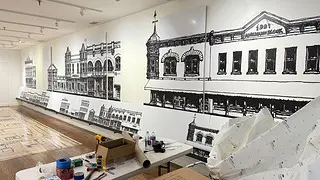
photo by: Clint Cargile
An in-progress view of ‘50 Years to Overnight Success: The Story of the Lockport National Historic District, 1975–2025,’ a new exhibit at the Gaylord Building that explores how preservation helped fuel downtown Lockport's economic revitalization.
Historic Preservation as an Economic Engine
In the 1960s and 70s, several local landmarks in Lockport were demolished by private companies to make way for new development. In response, residents began advocating for preservation solutions.
A handful of citizens began what would turn out to be a seven-year fight to protect Lockport’s Central Square, which developers were eyeing for a new shopping center. Meanwhile, historian John Lamb was busy nominating Lockport for inclusion on the National Register. Both parties were successful—the court ruled that Central Square belonged to the people and could not be legally sold, and Lockport Historic District was listed on the National Register in 1975.
Over the next few years, municipal employees worked with the U.S. Department of the Interior to pinpoint which buildings—if rehabilitated—could spur economic growth in Lockport. One of the buildings identified was the Gaylord Building.
Soon after, the Gaylord Building was purchased by philanthropist and businessman Gaylord Donnelley. Interested in adaptive reuse, Donnelley established the Gaylord Lockport Company, a group dedicated to rehabilitating the site.
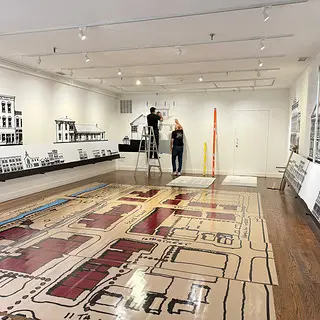
photo by: Clint Cargile
Artist Robert Morris and Lockport Mayor Steven Streit work together to install panels in the exhibit.
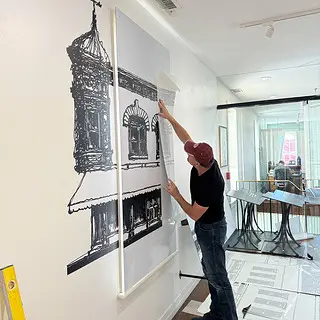
photo by: Clint Cargile
Lockport Mayor Steven Streit helped design and install the exhibit.
Collaborating with tradespeople, architects, and historians, the Gaylord Lockport Company spent the next four years completing their project. Their hard work paid off when President Ronald Reagan awarded the Gaylord Lockport Company the President’s Historic Preservation Award in 1988. This recognition proved that historic preservation could kindle opportunity, and that people were paying attention.
That trend continued when graphic designer Steven Streit ran for mayor. In 2012, he won the election and focused his efforts on art, economic revitalization, and historic preservation.
Stay connected with us via email. Sign up today.
Investing in Art and Historic Preservation
Today, Mayor Streit and his wife, Wendy Streit, champion art and historic preservation in Lockport through the Lockport Council of Arts, which they co-founded. Their creative programming has helped drive tourism and economic growth in the city.
One example of this effort took place last year, when Mayor Streit collaborated with local comic shop owner Joe Gentile to launch “Mission 1895.” This project invited people to explore Lockport’s downtown through a history and science fiction-inspired treasure hunt. One of the final clues was hidden in an exhibit at the Gaylord Building.
Through the Lockport Council of Arts, the Streits have organized annual events that emphasize art and history, including a festival that blended steampunk style with Lockport’s local canal history. Thousands attended, including developers David and Ed Mede, who were inspired to rehabilitate an abandoned downtown building as a restaurant and event space.
More adaptive reuse projects followed. According to the City of Lockport, between 2013 and 2025, the city saw more than 380 new businesses or business owners, more than 1,300 new-home permits, $1.3 billion in construction value generated through building permits, and more than $1.1 million in facade and fire alarm improvements funded through grants. Much of this activity was concentrated in Lockport’s historic downtown.
This synergy between art and historic preservation has served the city well. Clint Cargile, manager of public programs at the Gaylord Building, moved to the area two years ago in part because he was struck by the city’s architecture and history.
“Looking around town and seeing the architecture of the stores, the cool billboards that have a historical look and feel to them... I just thought, ‘this is a very cool looking town!’” said Cargile.
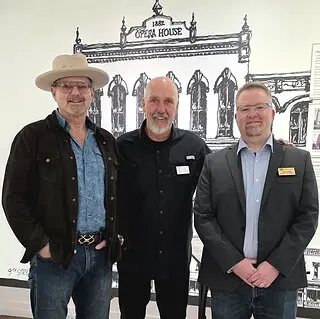
photo by: Donna Nevels
From left, Lockport Mayor Steven Streit, artist Robert Morris and Clint Cargile, manager of public programs at the Gaylord Building, collaborated closely on the exhibit.
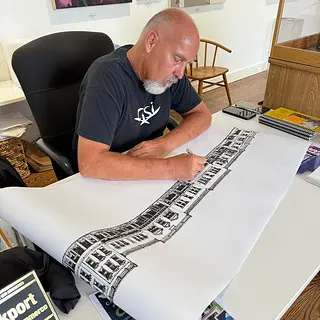
photo by: Clint Cargile
Artist and architect Robert Morris created drawings of buildings in Lockport's downtown for the exhibit.
Creating the Exhibit
When planning “50 Years to Overnight Success,” Owens and Cargile knew they wanted to explore this milestone anniversary through art.
This approach is fitting given that the Gaylord Building, previously a site of industrial labor, has since become a hub for artistic activity. It houses Gallery Seven (a local art collective), hosts a series of creative talks, and regularly offers its space free of charge to local art and theater groups.
One of the artists featured in Gallery Seven was Robert Morris. In addition to his work as an artist, Morris is an architect who serves on Lockport’s Heritage & Architecture Commission. He has contributed to the restoration of more than a dozen buildings in Lockport.
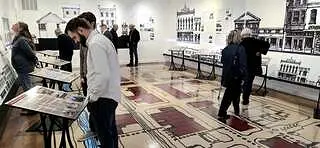
photo by: Donna Nevels
Guests explore the exhibit during its opening in November 2025.
“I kind of in the back of my head knew I wanted to collaborate with Bob [Morris],” said Cargile. He had seen Morris’ work and liked his pen-and-ink style.
Morris agreed to create drawings of Lockport’s downtown for the exhibit. He and Cargile identified eight buildings that played key roles in the revitalization. Each building is explored through a drawing and three panels, which show how the site stood in the 1800s, how it deteriorated over time, and what it looks like today after restoration. Installed on opposite walls, visitors can simulate the experience of walking down State Street and then turning around and walking up the opposite side while learning Lockport’s preservation story.
The floor of the exhibit is covered in a hand-drawn map of Lockport, which was designed by Morris and Mayor Streit.
When asked what guests may take away from the exhibit, Cargile says people will realize that it took a sustained effort from many people to revitalize Lockport.
“This exhibit is about understanding that place is important,” said Mayor Streit.
“When people know their stories, it gives them a sense of worth,” added Morris. “People in Lockport knowing our story gives the whole community a sense of worth.”
“50 Years to Overnight Success: The Story of the Lockport National Historic District, 1975–2025” opened in November 2025 and will remain on display at the Gaylord Building through March 2026. Also on display is “Illinois Waterways: Immersive Heritage,” an exhibit that was recently awarded a grant from the National Endowment for the Arts.
Save Historic Places That Tell Our Full American Story
When you join the National Trust, you help save historic and culturally significant places nationwide.