Updating a Modern Train Line In Chicago
Section 106 Success Story: Chicago’s North Main Line (Chicago, Illinois)
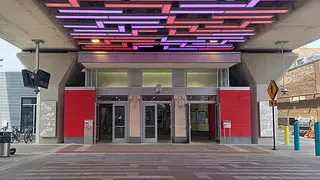
photo by: AlphaBeta135 via Wikimedia CC BY 4.0
Chicago Transit Authority's Argyle Station entrance (after reconstruction) as part of the Red and Purple Modernization Project.
The elevated North Main Line opened in 1900, creating a 7.5-mile transit route to the North Side of Chicago. Today the CTA operates the line, which is part of the city’s “L” system. It sits above historic neighborhoods and streets on tracks made of steel, some of which use technology from the 1880s. In 2012, it was determined eligible for the National Register of Historic Places.
The North Red Line (a section of the North Main Line) is one of the busiest in the CTA system, but its aging infrastructure was unable to meet increasing demand, and it needed substantial improvements. The Red and Purple Modernization (RPM) Project, the largest capital improvement project in CTA’s history, began formally in 2019 with a phased approach. In 2025, Phase One was substantially completed, and a multiyear planning process is underway for the next phase.
The Section 106 process was administered by the Federal Transit Administration (FTA), which provided $957 million to close the gap in funding for the $2 billion RPM Phase One project. Section 106 requires federal agencies to consult with parties that have an interest in historic properties when adverse effects are likely to occur.
A coalition spanning federal agencies, city preservation staff, neighborhood historical societies, and Tribal representatives came together to find a path forward. Consulting parties included the FTA; the Advisory Council on Historic Preservation; the Illinois Historic Preservation Agency (State Historic Preservation Office); the city of Chicago’s Historic Preservation Division; Preservation Chicago; Landmarks Illinois; Edgewater Historical Society; the Uptown Chicago Commission; Friends of the Parks; the Uptown Historical Society; the Miami Tribe of Oklahoma; and Uptown United.
What We Would Have Lost
Section 106 is sometimes perceived as an obstruction to necessary infrastructure projects. However, when the process is incorporated at the start of a project and mitigation strategies are agreed upon at the outset, Section 106 can help prevent roadblocks as the project evolves and leads to better outcomes. In the case of the Chicago Transit Authority’s (CTA) Red and Purple Line Modernization Program (RPM), Section 106 facilitated a smooth completion of Phase One of the project, which comes with several economic and community benefits, such as the ongoing development of 10 blocks under the new “L” tracks into public spaces. If enacted, the July 2026 proposed changes to the Section 106 regulations by the Advisory Council on Historic Preservation would undermine the opportunity for collaboration, likely resulting in a different outcome for projects like this one.
.webp)
photo by: David Wilson via Wikimedia CC BY 2.0
As part of the Section 106 review process the CTA brought together the community for a number of different public meetings, like this one in 2011.
Mitigation measures, such as successfully relocating the historic Vautravers Building for future reuse; and the development of 10 blocks of new community trails, plazas, and recreation space under the tracks, advanced alongside project construction. The Section 106 process demonstrated that preservation and infrastructure investment can be mutually supportive.
By addressing preservation concerns early through consultation, the project team ensured it moved forward smoothly. These outcomes preserved a key neighborhood asset, activated previously unusable land for public benefit, and serve as an example of how early consultation through Section 106 can enhance major infrastructure projects.
Adapted from the ACHP Section 106 Success Story with further information from the RPM website and Landmarks Illinios.