Charleston Place
A community-submitted Section 106 success story in Charleston, South Carolina.
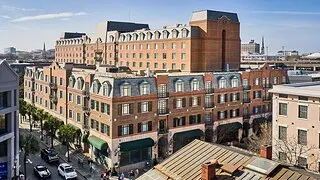
photo by: Katherinesluder via Wikimedia (CC BY 4.0)
To better align with the architectural character of Charleston’s historic district, the Charleston Place hotel stands eight stories tall rather than the nine originally planned as a result of the Section 106 process.
In the late 1970s, a proposal to build a hotel and convention center in the heart of downtown Charleston sparked a fierce debate over the balance between preservation and economic development. Initial plans called for a 419-room, nine-story hotel surrounded by a four-story perimeter structure at the former Belk department store site on King Street.
Because the city had received a federal grant to acquire land for the convention center and parking garage, the project was subject to Section 106 review, creating an opportunity for public consultation and allowing the Advisory Council on Historic Preservation (ACHP) to participate. Through that process, stakeholders acknowledged that the project would have an adverse effect on the historic district and worked together to identify appropriate mitigation measures. The Historic Charleston Foundation (HCF) urged a reduction in the project’s height and a reduction in the size of the parking garage to preserve not only the facades but also the front sections of the cast-iron commercial buildings on Meeting Street that were slated for demolition under the initial proposal. The HCF also expressed concern about the proposed large convention center component, which suggested an intention to attract large gatherings that could further increase the already significant number of tourists visiting the city.
In January 1979, members of the ACHP came to Charleston to take public testimony. At the hearing, the HCF went on record with conditional endorsement of the project, subject to a review of all aspects of the plan by a panel of architects brought in by the foundation.
The HCF subsequently brought three architects to Charleston, who issued a report supporting the concept of the project and its effort to line the perimeter of the site with low-rise structures. The architects recommended reducing the project’s height by eliminating two or three stories and advised against widening Market Street. They also urged the redesign to pay greater attention to the architectural character of King Street and recommended using the Art Deco movie theater across the street as a large meeting room rather than constructing a new gathering space.
What Would Have Been Lost
In the late 1970s, a proposal to build a hotel and convention center in the heart of downtown Charleston sparked a fierce debate over the balance between preservation and economic development. After expressing concerns, the Historic Charleston Foundation worked with the Advisory Council on Historic Preservation to move the project forward, subject to guidance and review from outside experts. For the Historic Charleston Foundation, Section 106 has provided it with an important seat at the table when federally involved projects could affect Charleston’s historic places and cultural resources. In Charleston, that opportunity has made a tangible difference.
In July 1979, the parties signed a Memorandum of Agreement (MOA) allowing the development to move forward. As a result of this process, Charleston Place was ultimately reduced to eight stories and significantly scaled back in scale and mass to better fit the architectural character of the historic district. The agreement also required the rehabilitation of the first 40 feet of nine historic buildings on Meeting Street, with their facades restored at municipal expense. In addition, the city agreed to implement a tourism management plan designed to minimize the impact of visitors and their vehicles on the historic district. In 1984, the project received final approval from the Board of Architectural Review, and the Charleston Place development opened for business in 1986.