U.S. 75 Reconstruction in Hinton
A community-submitted Section 106 success story in Hinton, Iowa.
The Hinton Business Corner Historic District contains five commercial and municipal buildings associated with the town’s rebuilding after a 1914 fire. Eligible for listing on the National Register of Historic Places, the district reflects Hinton’s early 20th-century commercial development.
The planned reconstruction of U.S. 75 will expand the highway westward, requiring the demolition of two contributing buildings: the Bank of Hinton, which is individually eligible, and Haas-Shuenk Hardware. Three other contributing buildings will remain.
Section 106 consultation began while the Iowa Department of Transportation (DOT) and the City of Hinton were still evaluating alignments. An early architectural survey identified the district before a preferred alternative was selected. Alternatives east of the existing road would have substantially affected railroad operations and an agricultural cooperative, and bypasses carried much higher costs and environmental and community concerns.
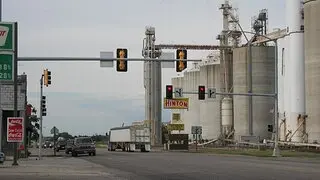
photo by: Dennis Carr/Fredddie via Wikimedia (CC by 2.0)
The planned reconstruction of U.S. 75 would require the demolition of two historic buildings in Hinton, Iowa.
The project team spent about a year studying whether the district could be relocated. A structural assessment found that Haas-Shuenk Hardware could not be moved, and moving only part of the district would not preserve it as a historic grouping.
The selected design therefore has an Adverse Effect on the district and the individually eligible bank. The Federal Highway Administration (FHWA), Iowa DOT, and Iowa State Historic Preservation Office (SHPO) signed an agreement requiring a mural and three interpretive panels explaining the district’s history be created. The agreement calls for professional preparation and SHPO review, while vibration monitoring will help protect the three buildings that remain. The roadway improvements will proceed, with the loss formally acknowledged, and the district interpreted within the community.
What Would Have Been Lost
Without early identification and sustained review by the Iowa State Historic Preservation Office (SHPO), preservation and interpretation of the district might not have been considered while meaningful alignment choices remained open. No other interested party joined the consultation, making the SHPO the principal independent preservation voice. The relocation study showed why moving only some buildings would not save the district. Without Section 106, the project could have proceeded without that analysis or the binding commitment to a mural, interpretive panels, and the mitigation documentation of these resources.
Visit Section 106 Under Threat for more success stories, information, and to take action.