Six Main Street America Communities Where National History Was Made
In the 250 years since the Founding Fathers gathered inside Philadelphia’s Independence Hall to sign the Declaration of Independence, some of the nation’s most transformative moments have unfolded in spaces of similar prestige. But a famous building isn’t a requisite for making history. Pivotal events also happened in unassuming small towns or cities and in locally designated historic districts—places that many Americans wouldn’t be able to quickly find on a map.
In commemoration of the United States Semiquincentennial, Main Street America, an independent subsidiary of the National Trust, gathered more than 250 milestones from Main Street America communities across the country, culminating in a virtual map called “History Happens on Main Street.”
These events aren’t limited to the past 250 years: Some stretch back decades or even centuries before 1776. Such is the case in Zuni, New Mexico, where a major turning point transpired in the late 1530s. At that time, the Zuni became the first Pueblo people known to have contact with European explorers—more than 80 years before the encounter between Mayflower Pilgrims and the Wampanoag people at Plymouth.
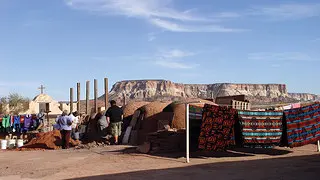
photo by: New Mexico True
In Zuni, New Mexico, tribal members still make bread in adobe hornos.
The Spanish had sent Franciscan friar Marcos de Niza on an expedition in search of the Seven Cities of Cíbola, a mythical place thought to be filled with gold. After one of the expedition members, an enslaved Moorish man, was killed by the Zuni, Niza returned to Mexico claiming to have found the Seven Cities. Another expedition, sent in 1540, found that these legendary cities were in fact the Zuni villages.
The encounter did not offer the riches Spanish leaders were looking for, but it did eventually lead to “a lot of cultural exchange,” says George Kanesta, board president at Zuni Pueblo MainStreet. The Spaniards introduced outdoor adobe hornos (ovens), which the Zuni adapted to create their own custom of baking and cooking in hornos, still practiced today.
In return, “Zunis [gave] the Spaniards a lot of farming techniques,” says Kanesta. “Much like Plymouth Rock and other encounters, without the Native people, the explorers wouldn’t have had a chance to survive.”
Across the country, in the vicinity of what is now the historic Phoebus neighborhood of Hampton, Virginia, another trajectory-defining moment occurred in 1610. That year, English colonizers overtook the Algonquian-speaking village of Kikotan. They killed or wounded some and forcibly drove out the rest of the village’s Indigenous population, and settled near present-day Phoebus.
Without the thriving farmland left behind by the Kikotan people, the English colonizers would have had a much harder time surviving there, says Main Street Manager Joe Griffith of the Phoebus Partnership. The area became part of the city of Hampton in 1952, and the Phoebus Historic District is now listed on the National Register of Historic Places.
“The English began harvesting the wheat and the corn and everything that they needed from the Kikotan fields. ... They didn’t have the knowledge or the means to farm their food,” says Griffith. “They benefited greatly from [their] aggressive occupation of the village.”
By the end of the 17th century, the Colonies’ settler population had exploded, growing from less than 1,000 in 1610 to more than 200,000 by 1690. It was during this decade that the notorious Salem witch trials would leave an indelible mark on the budding nation’s justice system.
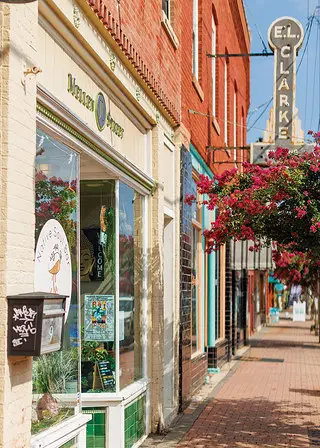
photo by: The Phoebus Partnership
The Phoebus Historic District’s main drag.
In 1692, a group of girls near colonial Salem, Massachusetts, claimed to have been cursed by local women and accused them of witchcraft. The panic-driven trials that ensued that year resulted in more than 150 imprisonments and 19 deaths by hanging.
“All that fear just started to take hold, and they convicted people based on what is called ‘spectral evidence,’” says Jill Christiansen, assistant education director at the Salem Witch Museum.
In spectral evidence testimony, a person claims to have seen the suspect’s spirit, or specter, causing harm in a vision or dream—meaning only the accuser can actually “see” the alleged proof. After Massachusetts Bay Colony Governor William Phips’s own wife was accused, Phips declared that spectral evidence could no longer be used to convict people in court.
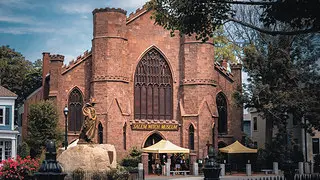
photo by: Ben Rekemeyer
The Salem Witch Museum was constructed in the 1840s.
“During the trials, you were guilty until proven guilty,” says Christiansen. “There was no assumption of innocence.”
The Salem witch trials inspired the inclusion of core tenets of the U.S. legal system—such as the presumption of innocence, the right to legal representation, and the right to a fair trial—that were codified over the next century.
Almost a century after the Salem witch trials, in January 1784, the Continental Congress gathered inside the Old Senate Chamber of the State House in Annapolis, Maryland, to ratify the Treaty of Paris, ending the Revolutionary War. This is when the United States legally became a sovereign nation, and yet Annapolis is often eclipsed by other sites of Revolutionary importance.
“If you think about the Revolutionary War, you’re going to think about Philadelphia; you’re going to think about the Battle of Lexington; you’re going to think about Yorktown, where the surrender occurred,” says Marcia Miller, who recently retired after a 35-year career with the Maryland Historical Trust. “People focus on these major events and don’t really stop to think about [Annapolis].”
The state substantially completed a meticulous restoration of the Old Senate Chamber in 2015. The project came about after the discovery that an early 1900s renovation may have inaccurately altered the room’s original appearance. Today, the space looks exactly as experts believe it did when George Washington resigned as military commander there in December 1783, a moment that has come to symbolize the rejection of monarchy and the birth of American democracy.
In Cartersville, Georgia, a different sort of symbol of American identity was uncovered in 1989. Young Brothers Pharmacy owner Dean Cox had long heard rumors that the east wall of his business was hiding a sweet piece of cultural history. Beneath about 25 layers of paint, Cox found what he was looking for: A Coca-Cola advertisement, the first of its kind for what is today the world’s biggest soda company.
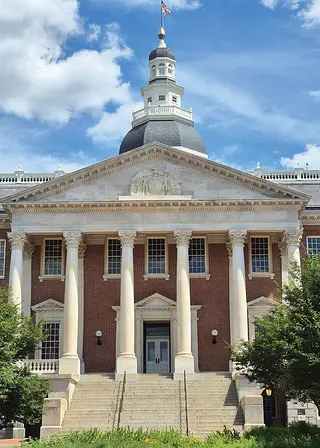
photo by: Erik Evans/Downtown Annapolis Partnership
The State House in Annapolis, Maryland.
“In 1894, an industrious Coca-Cola syrup salesman named James Couden actually painted the sign in the hopes of encouraging train riders to stop and drink Coca-Cola,” says Lillie Read, executive director of Downtown Cartersville.
After discovering the sign nearly 100 years later, Cox contacted The Coca-Cola Company, which verified that it was the brand’s first outdoor painted wall advertisement. He then assembled a team to restore the relic to its original condition.
Cox died in 2018, and Young Brothers Pharmacy shuttered in 2024. The historic structure is now home to Kilwins, an ice cream and chocolate shop.
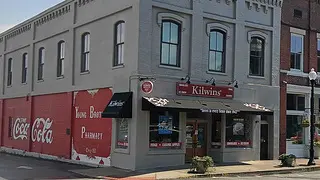
photo by: Downtown Cartersville
The Coca-Cola sign on a Cartersville, Georgia, wall dates to 1894.
“It is highly visible, bright red, very iconic,” says Read of the sign, which continues to attract tourists to Cartersville. “People know Coca-Cola, right? The advertising is familiar to us now, and I think people are really delighted when they see this is the first one ever, for something that feels so ubiquitous.”
In the small city of Washington, Iowa, visitors are similarly drawn in by a world first. In 2016, Guinness World Records officially named the town’s State Theatre the oldest continuously operating cinema in the world.
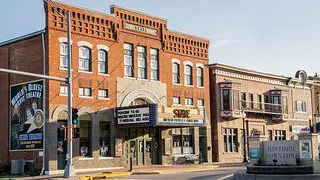
photo by: Leppert Media
The State Theatre’s exterior Art Deco detailing was restored in 2016.
Designed by Des Moines architecture firm Foster & Liebbe, the theater first opened as the Graham Opera House in 1893. (It was renamed the State Theatre around 1930.) Early managers Frank and Indiana Brinton are credited with bringing projected moving pictures to the business by the mid-1890s.
Michael Zahs, a retired teacher and historian, rescued the Brintons’ silent film collection from the basement of a local home in 1981, a discovery that would eventually lead to the Guinness recognition and a 2017 documentary, Saving Brinton.
“After [Saving Brinton] was shown all over the world, we’ve had people come from all over the world, so they can say that they’ve watched a movie in the oldest theater in the world,” says Zahs.
Fridley Theatres, the State Theatre’s owner since 2001, completed an exterior preservation project in 2016 that included exposing the original arcade storefront, returning Art Deco detailing to windows, and reconstructing the 1942 marquee.
“It’s the cornerstone of our downtown district,” says Main Street Washington board member Sally Hart. “Going to the movie theater and getting a bucket of popcorn, and a soda bigger than you need, and enjoying a movie next to your neighbors, is just part of your American identity—regardless of where you are.”
Save Historic Places That Tell Our Full American Story
When you join the National Trust, you help save historic and culturally significant places nationwide.