A St. Louis Park Renews Its Set of Whimsical Victorian Pavillions
The St. Louis Republic deemed the city’s Tower Grove Park “a source of boundless delight and purest pleasure” when it opened in 1872. It sprawled across a rectangle of 277 acres, donated by the British-born hardware tycoon Henry Shaw. The park, named after Shaw’s Italianate mansion, Tower Grove House, and adjacent to the botanical garden he founded, was starting to transform from grassy prairie to shaded woodlands.
Parkgoers also found refuge from the weather under polychromed, polygonal pavilions scattered around the grounds. The builders trimmed the structures’ domes, cupolas, and gables with fanciful cresting and filigree. An 1883 report described the results as “pleasing and ornamental,” an amalgam of “utility and variety” that supplied protection from the elements while “blending harmoniously with the landscape.”
All 11 of these gingerbread confections, despite their delicate appearance, have survived. They now rank as “the world’s largest set of Victorian park pavilions,” explains Bill Reininger, the executive director of Tower Grove Park, one of a handful of public city parks designated as National Historic Landmarks. Half of the site’s pavilions have recently been brought back to the way they appeared in Shaw’s time, with restoration work overseen by Amy Gilbertson, a principal at Trivers architecture firm. “I love the creativity” of the original designers, says Gilbertson, whose own team has creatively reinforced and upgraded the buildings’ components.
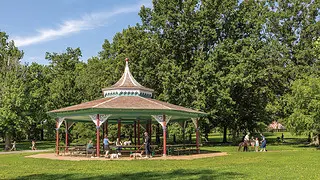
photo by: Sam Fentress
Filigreed elements enliven the Old Carriage Shelter.
Shaw hired protean architects and builders, including British-born George Barnett and Ohio native Eugene Greenleaf. They drew inspiration from overseas precedents as varied as Gothic cathedrals, Tuscan villas, Swiss chalets, Ottoman tents, and Chinese pagodas. At first, the park structures were collectively called “summerhouses.” But then they were gradually differentiated and named after their predominant architectural styles or the park’s nearby attractions, including a lily pond, a cypress grove, and a bronze statue of German naturalist Alexander von Humboldt. From the moment the shelters were unveiled, they were heavily used for relaxation and gatherings, Reininger explains. “I have pictures of my great-great-grandmother celebrating her birthday” at a cupola-topped octagon now known as Humboldt South, he says.
In the 20th century, even as Victorian ornament and eclecticism fell out of fashion, the structures were preserved by three generations of the Gurney family, who superintended the park. The patriarch, James Gurney Sr., was a horticulturist who had worked in England at Kew Gardens and then, upon immigrating to St. Louis in 1867, for Shaw. Reininger says, “We had almost 100 years of park management by one family directly connected to Henry Shaw, intent on keeping it as he intended.”
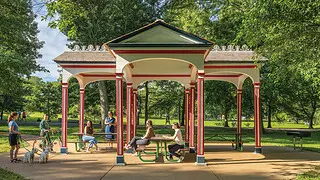
photo by: Sam Fentress
The Cypress South pavilion was restored in 2026.
By the early 2000s the pavilions showed their age, despite conservation efforts. Roofs had leaked. Ceilings painted sky blue were peeling. Brackets and spandrels had lost carved details. Columns had rotted. Brick pavers underfoot were uneven and prone to muddiness. Reininger says that “we prioritized the ones in worst condition” in 2018, when Gilbertson’s team took on the first phase of the assignment.
On the pavilions’ sloping and curvy roofs, craftspeople have repaired metal sheets and replaced damaged cedar shingles. For example, the Turkish Pavilion’s flared, crimson-and-white-striped roof tiers were patched with tin-coated steel. For the structures’ scrollwork trim, the workers have often filled in missing sections with paintable epoxy replacements to preserve as much of the historic fabric as possible, rather than inserting new millwork.
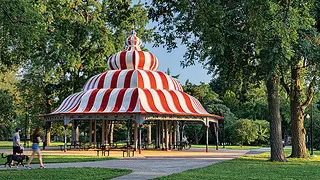
photo by: Sam Fentress
A striped roof tops the Turkish Pavilion.
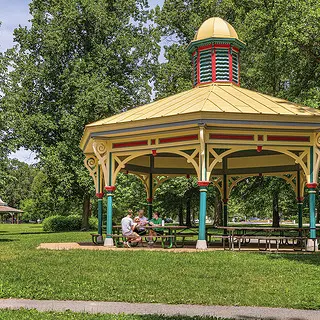
The Lily Pond Shelter, which has eaves supported by lacy archways, “was visibly leaning,” Gilbertson recalls. Straightening it made for a dramatic scene: “It was lifted completely out of the ground,” she explains, and new concrete footings were poured at the bases of its forest green columns. This pavilion was part of the restoration’s second phase, which ended this past May and included the Humboldt South (shown at top), Cypress South, and Old Carriage pavilions.
The redone shelters have been repaved in tawny aggregate concrete, which ensures compliance with the Americans with Disabilities Act (ADA). The project team installed light fixtures on nearby poles to provide nighttime illumination, with no visible electrical mechanisms to intrude on the pavilions’ silhouettes.
The park has spent $2.2 million restoring six pavilions (financed by a federal Save America’s Treasures grant, as well as individual and foundation gifts). The next phase, which will set the rest agleam again, is estimated to cost $2.5 million.
Reininger and Gilbertson report that the shelters awaiting treatment, as well as their restored counterparts, all remain in constant use. They serve, for instance, as headquarters for festival and athletic event organizers, settings for family picnics and milestone celebrations, and outdoor classrooms for day camps and programs run by Tower Grove Park and the Missouri Department of Conservation. Their images are even emblazoned on the park’s contemporary souvenirs, including postcards, T-shirts, prints, and stickers.
“We have the best collection of these buildings in the world; we highlight them as much as we can,” Reininger says. They are as pleasing, ornamental, useful, and varied as they were when his own ancestors celebrated his great-great-grandmother’s birthday under an octagon’s cupola.
Save Historic Places That Tell Our Full American Story
When you join the National Trust, you help save historic and culturally significant places nationwide.