A Toolkit for Change: Guidance from the Los Angeles Women’s Landmarks Project
Resources for rethinking the historic designation process in your community.
If you're traveling through a city and you notice that 95 out of 100 historic places revolve around significant men, how could you avoid absorbing the mistaken impression that men were the only real movers and shakers of American history? That steep gender bias is our national reality: only 5 percent of National Historic Landmarks are designated in recognition of women's history.
For those who have ever been frustrated by this imbalance, then the Los Angeles Women’s Landmarks Project’s (LAWL) toolkit for change has solutions for you.
Our Missing History: Building a Toolkit for Change
This webinar is brought to you by Preservation Leadership Forum and the Los Angeles Conservancy.
LAWL is a joint effort of the National Trust's Where Women Made History (WWMH) initiative and the Los Angeles Conservancy (LAC). Approximately 2 percent of L.A.'s Historical-Cultural Monuments (HCMs), the city’s equivalent of “local landmarks,” currently honor women's contributions to history. LAWL is changing that by identifying underappreciated sites connected to women’s pasts, prioritizing stories whose invisibility was compounded through intersecting marginalization by race, ethnicity, class, sexual orientation, religion, or disability.
From May through August 2024, Arabella Delgado, the LAC's Women's Heritage Intern and a PhD candidate at the University of Southern California, reviewed 43 HCMs that should have included women’s histories to analyze whether they did or did not incorporate women's achievements into their documentation of significance. Delgado’s research underpins LAWL’s toolkit. The tools created by LAWL's collaborators are works in progress, models for reflection, and springboards for action.
The absence of women's representation across historic sites implies to women and girls that their stories are less significant than men's, undergirding the assumption that men are entitled to public space and commemoration in ways that women are not. But when women and girls see themselves as powerful presences across history, they feel empowered to step into their full selves.
Where do we even start when looking for missing histories?
Embarking on a project to uncover hidden histories can feel like an enormous and daunting task, but there are easy, scalable ways to address underrepresentation without rebuilding an entire designation system from the ground up. Start with a small, manageable sample of sites to get the lay of the land.
Delgado found that there was a spectrum of underrepresentation and misrepresentation across a sample of 43 HCMs. For example, the Bradbury Building's nomination makes no mention of women's histories, even though Simona Martínez Bradbury played a pivotal role in the iconic building's design, material selection, and construction.
Sometimes women were mentioned as figures tangential to the place’s "main story." In the nomination for Case Study House No. 8, an innovative mid-century modern home, Charles Eames is described as the site's owner and architect. Ray Eames—herself a multi-media artist, designer, and filmmaker—is mentioned primarily as Charles' wife, neglecting her role as a creative partner. The nomination's period of significance terminates with Charles' death, although Ray continued to live in the home.
Selecting and analyzing a small sample of sites or existing landmarks provides insights into patterns of inaccuracy or omission that must be addressed.
Resources in the Toolkit
- Some Simple Steps to Get Started (PDF)
- Slide Deck from March 31, 2026 Webinar (PDF)

photo by: KW Reinsch/Flickr/CC BY-NC 2.0
The iconic Bradbury Building is just one of the HCM’s researched as part of LAWL that should be amended to include the role Simona Martinez Bradbury played in the building’s design and construction.
How can we decide which historic sites should be priorities for recognition and preservation, especially when there are so many possible candidates for designation?
Ranking sites according to historic significance, physical integrity, or threat level isn't always simple. Subjective assessments and mismatched definitions of key terms can stymy nominations’ progress.
Chris Morris (the leader of WWMH), Lindsay Mulcahy (the former neighborhood outreach manager at LAC) and Delgado co-created an impact scoring system to measure how well a prospective new HCM or amendment supports LAWL's values and objectives. The system balances quantitative and qualitative analysis, facilitating a narrative exploration of a site’s significance while generating numerical scores based on how well they represent LAWL’s values.
The matrix is divided into two sections. The first measures how a proposed amendment or designation will impact the preservation landscape. Will it tell previously invisible histories? Is it in a neighborhood that has been overlooked for designations generally? How might it set useful future precedents for greater equity in designations?
The second section assesses the urgency of preservation. Is the site's surrounding community mobilized to protect it? Is it subject to threats like wildfire or gentrification?
The impact scoring system is efficient and intuitive. Its analytical categories prompt thoughtful conversations with LAWL’s partners, building toward consensus while allocating limited time and resources.
Resources in the Toolkit
- How to Evaluate Your Landmarks in 5 Steps (PDF)
- How to Evaluate Your Landmarks in 5 Steps: Los Angeles as a Case Study (PDF)
- Template: Evaluating Historic Sites (PDF)
- Sample Evaluation: Mack Sennett (PDF)
- Template: Setting Priorities with an Impact Score (PDF)
- Template: LAWL Impact Score (Spreadsheet)
Stay connected with us via email. Sign up today.
How can we edit past nominations to fully illuminate hidden histories?
We know that historic places aren’t frozen in time–so their documentation shouldn’t be, either. However, mechanisms for amending local nominations to more fully incorporate underrepresented histories are often inconsistent and difficult to apply. A replicable, standardized method for adding missing histories into sites’ narratives is sorely needed.
LAWL is tackling this necessary work, creating a model for amending previously designated HCMs to include women's histories in all their complexity. LAWL is collaborating with the City of Los Angeles and the Los Angeles Office of Historic Resources to define a reproducible amendment process. While LAWL is focused on intersectional women's histories, the intention is to expand documentation and better represent all underrecognized dimensions of a site’s story.
Delgado's research indicates that mechanisms for amendment are often nonexistent or underutilized. Investigate the logistics of amendments in your city, county, or district to determine what’s possible. The process may be set up to simply facilitate technical amendments – adjusting a site’s boundaries or documenting a change in ownership, rather than expanding the historic narrative. In rare cases, the existing system may permit additions to a site’s significance, allowing you to tell a fuller American history.
Resources in the Toolkit
- Slide Deck: Women’s Heritage in Los Angeles: An Overview of the Representation of Women in Existing Historic-Cultural Monuments in Los Angeles, California (Presented by Arabella Delgado on July 17, 2024) (PDF)

photo by: Chris Morris
The Etta James Residence will be one of the new HCM's nominated as part of the LAWL, recognizing the international legacy of this Grammy award winning performer. If designated, this HCM will be the first one in the Athens on the Hill neighborhood.
How can we find women's stories in unexpected places?
LAWL’s project team knows tracking down women’s histories can be challenging. Women’s achievements haven’t always been well documented by the print records we most often use to reconstruct our past. Oral histories are often vital to enriching our understanding of women’s lives and accomplishments. One such example is We Do Declare: Women’s Voices on Independence, the Smithsonian American Women’s History Museum’s initiative commemorating America 250.
Resources like Heather Huyck's Doing Women's History in Public and the National Collaborative for Women's History Sites' Telling Women's Stories toolkit can provide additional support for telling women’s histories. Digital resources accessible via the Library of Congress, the Digital Public Library of America, and the Internet Archive can also be helpful
Resources in the Toolkit
- Women’s History Research Guide (PDF)
How can we find allies in our advocacy work?
Every collaboration begins by simply reaching out.
The collaborative partnership between the National Trust and the Los Angeles Conservancy created a solid foundation for research and community engagement.
To build productive connections, consider your current professional network. Who might be interested in your project’s principles and objectives? Invite collaborators’ suggestions and participation. How might you value and compensate participants for their time and expertise?
Continually inviting people into conversation is key to generating new ideas and building a critical network of support.
Resources in the Toolkit
- The Importance of Outreach & Partnerships (PDF)
- The Alliance Review: Something We All Can Agree On–Women’s History is Our History (2025, No. 4) by Christina Morris
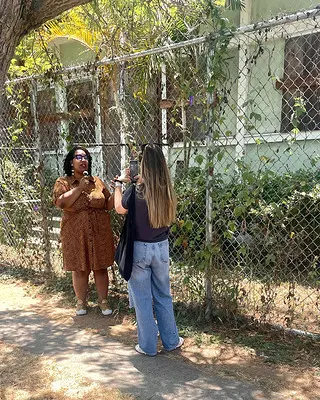
photo by: Chris Morris
As part of the work of LAWL and in partnership with the University of Southern California Heritage Conservation graduate program, students like Eliza Jane Franklin (left) filmed videos of HCMs being researched as part of the amendment process. Here Franklin speaks about the Monday Women's Club, an African American women's club in the Oakwood neighborhood.
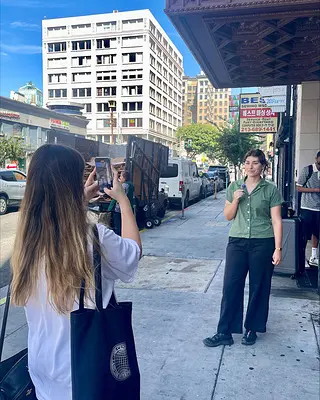
photo by: Chris Morris
In another video for LAWL, USC graduate student Zoe Detweiler speaks about the Garment Capitol Building by one of L.A.'s earliest woman developers, Florence Casler. Located in the Fashion District of downtown Los Angeles, it is another HCM being researched for amendment to incorporate immigrant women's history and women's labor rights.
What’s Next?
LAWL’s toolkit includes several tools for use in changing how you approach designations in your community: steps to get started, a landmark assessment form, key questions about landmark evaluation, Delgado’s report on L.A.’s HCMs, an impact scoring template and explanation, and guidance on outreach and partnership. All these resources are intended to support preservationists’ efforts to tell more inclusive, accurate histories across the United States.
Preservationists often perpetuate past erasures through how we implement existing systems for historic site designation. Systems can't correct themselves; we as preservationists must take an active role in changing our trajectory.
Save Historic Places That Tell Our Full American Story
When you join the National Trust, you help save historic and culturally significant places nationwide.