9 Visions of Winter at Historic Sites
Explore objects and art from the collections of National Trust Historic Sites and Historic Artists' Homes and Studios.
When you close your eyes and think of winter what does your mind conjure up? The stillness of a fresh snowfall? A home filled with warmth against a blustery wind? We posed this question to our historic sites (NTHS) and members of the Historic Artists’ Homes and Studios program (HAHS), and the result was a vision of winter that was not only embedded in nature but also about finding joy in the changing season. Each one of these objects and art have a story to tell.
Weir Farm National Historical Park (HAHS, Wilton, Connecticut)
This pastel was created by Julian Alden Weir’s eldest daughter, Caro Weir Ely, for her son-in-law Gregory Smith. It offers a quiet snapshot of Old Lyme, Connecticut in the heart of winter. Snow dances across a winding road leading to a quaint farmhouse surrounded by stone walls blanketed in white. The barren forest is accented with soft pops of blue, suggesting evergreen trees. Ely allowed much of the earth-toned paper to shine through, creating visual depth with negative space. Her fondness for winter scenes is evident throughout her work, especially in the multiple snow-filled etchings she created for her annual family Christmas cards.— Elizabeth Poland, Museum Curator
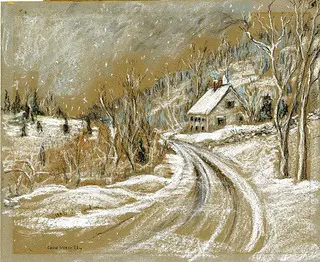
photo by: Weir Farm National Historical Park
Untitled, Caroline Weir Ely, Not dated. Pastel and pencil on paper, 10" x 12". WEFA 16962.
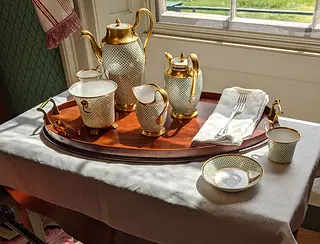
photo by: Montpelier
A Pierre-Louis Dagoty tea set at Montpelier. One of the saucers holds a shard, found by archaeologists in 2008, that that matches the pictured set.
James Madison's Montpelier (Orange, Virginia)
Dolley Madison felt the chill of winter at Montpelier in 1831, complaining in a letter to her cousin Betsy Coles, “This last, Norwegian Winter, has proved too cold for me.” Perhaps she and James took comfort in a cup of hot coffee or tea, served from their French porcelain dinner and beverage service. Manufactured by Pierre-Louis Dagoty in Paris ca. 1805, the set featured a green lattice design with gilt decoration and included a teapot, coffee pot, sugar bowl, cream pitcher, cups, saucers, and dinner and dessert plates.
Fragments found by archaeologists on site in 2008 show the set was in use at Montpelier, and it appeared on lists of the widowed Dolley’s furnishings in Washington D. C. Portions of the set passed down through the family of Dolley Madison’s sister Anna Payne Cutts, whose descendant Gertrude Storey Akers donated the tea and coffee service to Montpelier in 2020. Senior Researcher Hilarie Hicks
Albin Polasek Museum & Sculpture Gardens (Winter Park, Florida)
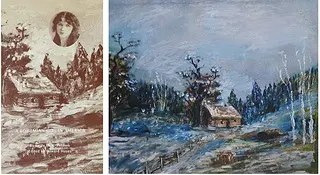
photo by: Albin Polasek Museum & Sculpture Gardens
Untitled, Emily Muska Kubat Polasek, c. 1900s. Oil on Masonite.
Winter, with its hardships and stark beauty, threads through the shared story of Albin and Emily Polasek, both of whom immigrated from the Czech lands in the early 1900s and began new lives in the American Midwest. In this painting by Emily, a modest cabin rests in the Wisconsin wilderness beneath a hushed blanket of snow. Chosen for the cover of her autobiography, the image represents a place of refuge and portrays the emotional burden of the immigrant journey. Like Emily, Albin Polasek arrived from Europe and forged his future, carving his path as one of the foremost sculptors of the twentieth century through determination and talent. The quiet warmth of this painting would have resonated deeply with Polasek, reflecting the courage required to build a new life in an unfamiliar land. — Tamie Diener-Lafferty, Curator
Edith Farnsworth House (NTHS, Plano, Illinois)

photo by: Tom Rossiter/Edith Farnsworth House
A daytime shot of the Edith Farnsworth House, taken as part of a yearlong study of the house by Tom Rossiter.
"For many years I have looked deeply at the intersection between architecture, culture and nature. This has manifest as a body of work in each of these arenas separately, but it often looks at the intersection of these three things." —Tom Rossiter, FAIA
INHABIT, by 2025 Artist in Residence Tom Rossiter, offers a yearlong study of the Edith Farnsworth House through time-lapse photography. Using two perspectives—a wide exterior view from across the Fox River and an interior view looking outward, where the house becomes a frame for the landscape—each camera captures a still image every 20 seconds over a continuous 24-hour period, once in each of the four seasons.
Thomas Cole National Historic Site (Catskill, New York)
This nineteenth-century watercolor depicts partridgeberry, an evergreen groundcover whose scarlet berries provide a pop of color to snowy winter landscapes. The artist Emily Cole (1843-1913), the daughter of artist Thomas Cole, painted this work from direct observation at her home in Catskill, New York, now the Thomas Cole National Historic Site, where she lived and worked her entire life. Cole was an acclaimed artist who found inspiration in the seasonal flora of her Hudson Valley home. — Amanda Malmstrom, Associate Curator
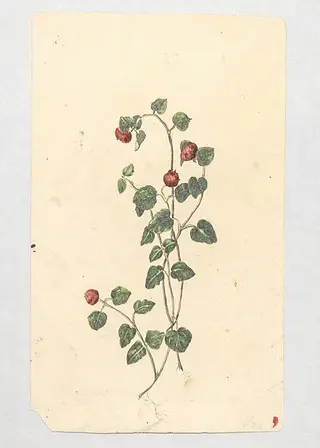
photo by: Thomas Cole National Historic Site, Gift of Edith Cole Silberstein
Emily Cole (1843-1913), Untitled (Partridgeberry), 1873, watercolor and pencil on paper, 7 5/16 × 4½ in. Thomas Cole National Historic Site, Gift of Edith Cole Silberstein, TC.2002.2.19.1.
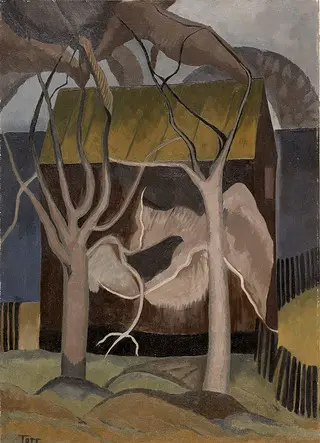
photo by: Arthur Dove/Helen Torr Cottage, The Heckscher Museum of Art
Helen Torr, American, 1886-1967, January, 1935, Oil on Canvas. The Heckscher Museum of Art. Gift of Mrs. Mary Rehm. Conserved in 2021 through the Adopt a Work of Art Program with funds donated by the Deborah Buck Foundation.
Arthur Dove/ Helen Torr Cottage, Heckscher Museum of Art (Centerpoint, New York)
Helen Torr created this painting of a barn and silvery beech trees while living in Geneva, New York, the hometown of her husband, modernist Arthur Dove. The twisted branches and somber palette evoke the bleak winter, while the transformation of dead leaves into a canopy of smoke or clouds creates an air of mystery within the painting. During the 1920s Dove and Torr lived many years in and around Huntington, New York, aboard their yawl Mona. In 1938 they settled in a cottage on the Titus Mill Pond, where they spent the remainder of their lives. The historic Arthur Dove and Helen Torr cottage is now part of The Heckscher Museum of Art. — Jill Rowen, Public Relations/Marketing
Kykuit (NTHS, Tarrytown, New York)
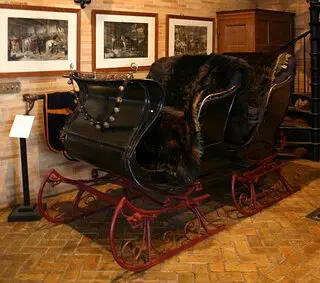
photo by: Kykuit
A two-seat sleigh by the Thompson Brothers (Portland, Maine), ca. 1890. This sleigh is on display in Kykuit's Coach Barn.
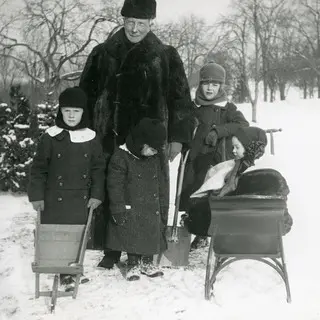
photo by: Rockefeller Archives Center
John D. Rockefeller, Sr. and grandchildren on one of their winter excursions.
John D. Rockefeller, Sr. took a daily interest in the horses, trails, and carriages at Kykuit, providing detailed instructions for the design and maintenance of the estate’s vehicles and trails. When the property was blanketed with snow during the winter months, sleigh rides were an enjoyable outdoor activity and a convenient mode of transportation for the family. This two-seat sleigh in Kykuit’s Coach Barn is lined with bearskin furs for extra warmth and comfort, and its jingle bells provided a festive warning signal as it glided by.— Elizabeth Marriott, Collections and Curatorial Projects Assistant at The Pocantico Center
Olana State Historic Site (Hudson, New York)
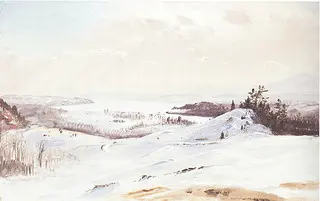
photo by: New York State Office of Parks, Recreation and Historic Preservation, Olana State Historic Site
Frederic Edwin Church, "The Hudson Valley in Winter From Olana," c. 1871-1872. Oil paint on academy board, 11 ¾ x 18 ¼ inches.,OL. 1980.36.a
Frederic Church’s landscape paintings were masterful combinations of foreground, middle-ground and background elements, and Olana’s physical landscape was composed by Church in similar ways. The steep hillside beneath Olana’s main house serves as a foreground setting when viewed from above, and the vast background—the “viewshed” —includes Inbocht Bay in the Hudson River, with the Catskill Mountains rising to the west beneath an ever-changing sky. This is the view which Frederic Church painted numerous times, even in winter, and it was this winter scene in particular, which served as evidence during legal hearings in the 1970s and helped to stop a nuclear power plant from being built. — Melanie Hasbrook, Director of Advancement and Marketing
Bush-Holley House, Greenwich Historical Society (Cos Cob, Connecticut)
Winter was a favorite time of year for John Henry Twachtman, one of the founders of the Cos Cob art colony. He delighted in painting snowy landscapes. On one occasion he wrote to the boarding house owners, that he was arriving the next day with 30-35 art students to paint the recent snow fall that covered this coastal neighborhood. Elmer Livingston MacRae, Twachtman’s protégé, shared his teacher’s love of painting winter scenes.
In 1900 he completed Schooner in the Ice, an oil on canvas that captures the ice flows on the Mianus River across from the boarding house where he lived. In the foreground a masted cargo ship is trapped by the ice at the dock, while in the background a freight train efficiently transports goods despite the weather—an excellent metaphor for the 20th century and mankind’s efforts to conquer the natural world. — Kathy Craughwell-Varda, Curator
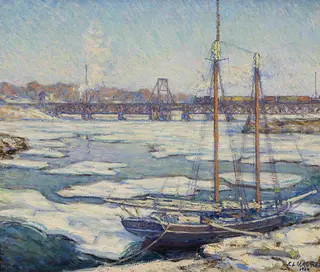
photo by: Bush-Holley House, Greenwich Historical Society
Schooner in the Ice by Elmer Livingston MacRae (1875-1953), 1900. Oil on canvas. Greenwich Historical Society, Cos Cob, Connecticut, Museum purchase
Save Historic Places That Tell Our Full American Story
When you join the National Trust, you help save historic and culturally significant places nationwide.