What is a Nation Without its History?
A recap and reflection on the 2026 National Preservation Summit.
When Brent Leggs, president and CEO of the National Trust for Historic Preservation, took the stage on September 23 at the start of the National Preservation Summit, he asked the audience to consider a question:
“What is a nation without its history?”
Brent Leggs, National Trust for Historic Preservation
The question was rooted in a reflection on the events of 1949 when President Truman signed the National Trust’s Congressional Charter. Leggs observed that—as we also see in our work today—many Americans “recognized that tangible connections to our nation’s past deserved to be memorialized for future generations rather than irreversibly sacrificed to the bulldozer, the wrecking ball, and the highway.”
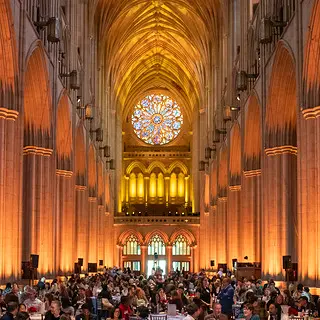
For those gathered online and at the Washington National Cathedral, a place that has a long history of inclusion and connection, this question framed the panels that followed, and became a call to action.
We started the day talking about some of the most existential threats facing the preservation field. We heard Alan Spears from the National Parks Conservation Association, Marion Werkheiser from Cultural Heritage Partners, Ira L. Matt (Séliš) from the National Association of Tribal Historic Preservation Officers, and Betsy Merritt from the National Trust describe the challenges facing Section 106 of the National Historic Preservation Act.
They discussed what the proposed changes to the Section 106 regulations mean for the preservation of our full history and how we have a responsibility, as articulated by Matt, to think “seven generations out,” where we look beyond our own personal gain to how our response to today’s threats will impact the community and the generations that follow.
Historic Preservation Defense Fund
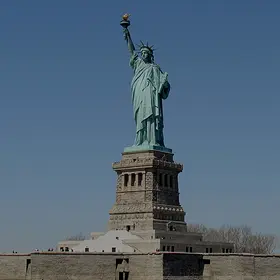
Announced at the National Preservation Summit, the Historic Preservation Defense Fund is an effort to raise an initial $10 million to protect our nation's historic places, and the laws and principles that safeguard them, from irreparable harm.
“Use your voice while you still have it.”
Marion Werkheiser, Cultural Heritage Partners
In a panel moderated by Erin Barnes, the president and CEO of Main Street America, we were treated to a conversation about place-based solutions and opportunities we face in the final months of the semiquincentennial. The speakers, who included Yiselle Santos Rivera, president-elect of the American Institute of Architects, Justin Garrett Moore of the Mellon Foundation, Elizabeth Rosin of Heritage Consulting Group, and former National Park Service director Chuck Sams, now of the Northwest Power and Conservation Council, provided practical reminders for how we do the work of preservation.
They, along with panelists throughout the day, urged us to challenge and activate each other to get into the fight. As summarized by Rivera, the panelists said: to look up to the federal level and reach out to your representatives, to look locally at decision-making happening in your immediate environment, to look beyond by making human connections to push back against efforts to divide and disconnect, and to look within to understand your own place in this conversation.
“Democracy is a contact sport.”
Chuck Sams, Northwest Power and Conservation Council
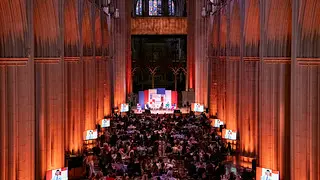
photo by: David Keith Photography
The afternoon panel focused on "250 Years of Promise: History, Memory, and Democratic Ideals."
After lunch we moved to a conversation with author and scholar Sarah Lewis and civil rights lawyer Sherrilyn Ifill. Using the question at the center of the new exhibition If Emmett Till Lived: Freedom on American Ground, Lewis and Ifill asked the audience to reckon with their choices and actions by prompting us to consider “What is the work still undone?”
They asked us to look past the body of Emmett Till to consider his life and what it could have been. Together, the speakers gave us permission to see the world anew and consider our role as witnesses, as evidence gatherers, and as individuals with the power to reimagine a better future through a shared understanding of the past. They urged us to see how the places we commemorate, like Roberts Temple Church of God in Christ, which hosted Emmett Till’s funeral and became a turning point in the Civil Rights Movement, are tangible evidence of how places embody the lessons of the past.
“When you see the nature of the places that allowed us to marshal our strength and make the turn [like the moment at Roberts Temple], it should empower us to believe that we can confront the forces of injustice and inequality. ”
Sherrilyn Ifill, Howard Law School
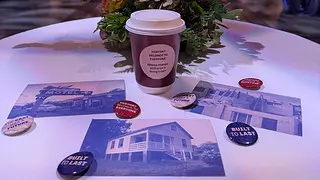
photo by: Kelly Paras
The Summit encouraged conversation and networking for those who attended in person, using buttons, postcards, and coffee cups to promote discussion.
The second post-lunch panel used the power of story to ask attendees to re-examine the role of history, memory, and democratic ideals in our work of saving places. This panel—which featured Huy Pham of Asian & Pacific Islander Americans in Historic Preservation, Angela Thorpe Mason of the Pauli Murray Center for History and Social Justice, Annie Polland from the Tenement Museum, and Sehila Mota Casper from Latinos in Heritage Conservation—used the language of song, imagery, and first-person stories to show how each moment in history has a ripple effect into our present circumstances.
They also asked us to consider our toolbox in this fight. They urged us to build connections between narratives, to redefine integrity not as a part of the designation process but as a part of our role as people doing the work of preservation, to consider what it means to be truly community-centered (Casper emphasized how “people are primary resources”), and to look to models of the past to pledge to do one thing every day to make a difference beyond our typical audiences. In short, to reconsider both authority and agency in the work of preservation.
“What songs are we singing, to whom, and is anybody listening?”
Huy Pham, Asian & Pacific Islander Americans in Historic Preservation
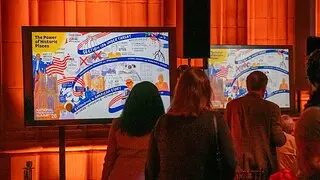
photo by: David Keith Photography
Yolanda Liman, a graphic recorder, produced this image (seen here as a work in progress) to highlight key themes and messages from the Summit.
The final panel of the day—a keynote by architect Michael P. Murphy followed by a conversation with former Senator William H. Frist—took us on a journey through place and how it shapes our health and wellbeing. It was a reminder of the importance places have on our work, looking not only at buildings, but also at the land, the air, and the living world. All these elements are essential in understanding the role of place in our history and our future.
“...Spiritually, emotionally, neurochemically, and physically we are transformed by the spaces around us every day and that the agency to make those spaces is what can make us more human.”
Michael P. Murphy, AMMA
In one sense, “What is a nation without its history?” is not only a prompt and a call to action, but also a vision of a future if we were to stay silent. Throughout the day, panel after panel, we were given the tools that we will need to act, not only as individuals but also as a movement, because as Leggs said, “we share the same goal: to expand the American story, not to shrink in the face of a challenge. Together, we are one movement. We can, and we will, save the historic places that have shaped our history. We represent communities that are looking to us to lead and we won’t let them down. Let’s get to work."
Recordings of the 2026 National Preservation Summit are available for a limited time.
Save Historic Places That Tell Our Full American Story
When you join the National Trust, you help save historic and culturally significant places nationwide.