An Interview With the Team Behind Woodlawn Cemetery's New "Where Harlem Rests" Tour
Across Woodlawn Cemetery’s 400 leafy acres in the Bronx, New York, you’ll find the graves of famous people such as Celia Cruz, Herman Melville, Miles Davis, and F.W. Woolworth. Many of its other inhabitants also led noteworthy lives in various contexts—including the Harlem Renaissance, which was centered roughly 8 miles from the cemetery. Inspired by volunteer research, as well as books by journalist and author A’Lelia Bundles and historian Eric K. Washington, Woodlawn Cemetery and Conservancy Director of Development and Programs Meg Ventrudo decided this historical period of Black cultural, artistic, and intellectual influence would make a good theme for a new cemetery tour.
The National Trust’s African American Cultural Heritage Action Fund provided most of the funding for the tour’s creation, led by Washington. It launched this spring with a self-guided version accompanied by written descriptions; narrated trolley versions are occasionally available, too. We spoke with Ventrudo and Washington about the tour, which is called “Where Harlem Rests.”
What was the impetus for this project?
Meg: We noticed through the work of our volunteers, as they were searching notable burials, that there were a lot of African American individuals buried in the southwest corner of the cemetery. As we started doing more research, we realized many of them were people of significance around the era of the Harlem Renaissance. And so for us, one of our questions was, “Why Woodlawn?”
What did you find out?
Eric: My sense is that while there was no single explanation, [one of] the likely reasons had to do with the transportation convenience. The number 4 subway train opened early in the 20th century, coinciding with the Harlem Renaissance and Blacks being that much closer to the cemetery. Even before then, the railroad stopped there.
Another factor, I think, was that undertakers have a general understanding of the lay of the land in terms of cemeteries that are available. And they could recommend it easily. Another is that, in life, people often move to places where they have connections, be they family connections or friends. I think being buried is the same thing. So those combined reasons probably would induce people to come in such numbers from a particular place, Harlem, to the Bronx.
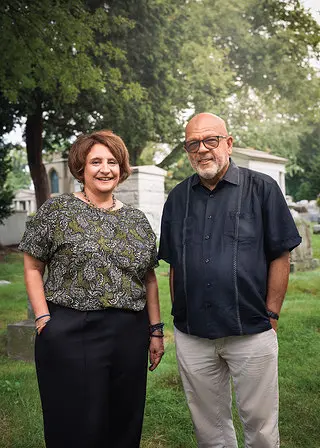
photo by: Mo Daoud
Meg Ventrudo and Eric K. Washington at Woodlawn Cemetery in the Bronx, New York.
Eric, how did you become interested in Woodlawn?
Eric: My grandparents are buried there, and some other relatives. So I knew about Woodlawn, and it has long been on the radar for New York public historians and cemetery tourists for having a “collection” of notable Black figures—particularly from the Harlem Renaissance era, but also in the entertainment field. I was excited because as somebody who researches Harlem, I know that it’s not all entertainers, and there were other integral figures in the community.
Do both of you have any favorites among the people highlighted on the tour?
Eric: Jacob Cantey was a Pullman porter, and his route went past the cemetery and through the Bronx. He was buying up property in the Williamsbridge and Wakefield sections of the Bronx and encouraging Blacks to move up there. This was before Blacks had moved up to Harlem. He was ahead of his time as an early advocate for Blacks moving up to the Bronx, many of whom would end up in Woodlawn.
Also, Bessye Bearden. Everybody knows her son, who is the artist Romare Bearden. But she was a celebrity before he was an adult. She was a society journalist, and anybody who’s doing any research of the Harlem Renaissance inevitably reads a lot of her articles about what events were taking place and who attended those events.
Meg: Madam C.J. Walker and A’Lelia Walker, because their stories are so inspirational. From Woodlawn’s point of view, Madam Walker’s gravesite is a site where people, primarily women, come and leave a dollar on her gravesite. I think they’re looking for inspiration and luck when they’re starting their new businesses, drawing on Madam Walker’s entrepreneurship. And then her daughter, A’Lelia Walker, was such a wonderful patron of the arts during her lifetime.
Eric: The Walker women are better known than a lot of the others on the tour. [Having their gravesites as part of the tour] helps to position the others and gives some context as anchors.
How can people take the self-guided version of Where Harlem Rests?
Meg: People can download the printable tour booklet from our website, or, if they come to Woodlawn, we have copies available. A portion of it is on Bloomberg Connects, so you can walk around with your phone and it will take you out to the southwest corner. We have not added the north side to Bloomberg Connects yet, but we will soon.
What do you want this project to achieve?
Eric: We often hear how [the] Harlem [Renaissance] had an influence that was worldwide, but when we talk about it, we tend to still talk about it within the certain geographical area. So I like the idea that it’s nudging people to look at [that movement] beyond the geographical borders as extending to other parts of the city and other parts of the country and even outside the country.
People tend to think also if they hear [about] Blacks in New York, that they were in Harlem, even if we’re talking about the 17th or 18th century. No, it was all part of an evolution, an organic process, with migrations and what have you. We didn’t just kind of sprout up above 96th Street.
Meg: We tend to think historically about the first, the best, the most. But this is a story of the influencers and the people on the ground that make society run and that work in careers and associations that help make a community. And I think that’s a wonderful story to tell.
Eric: I think that urban cemeteries are really a microcosm of the living world at large. And there’s no subject that passes through the living world—politics, the arts, race, whatever—that you can’t also discuss in the cemetery. I mean, all of the players are there, all of the varied occupations and interests and ambitions. I like to think that they like having the company.
Save Historic Places That Tell Our Full American Story
When you join the National Trust, you help save historic and culturally significant places nationwide.