Take a Break with 9 Daybeds at Historic Sites
Daybeds and chaise lounges seem to encapsulate the drowsiness and languidity of the late summer season. Outdoor activities and gatherings can feel dulled by the scorching afternoon sun, while voices are muffled as the heat bends sound waves upward and away from the ground. A desire to retreat to cool indoor spaces is pervasive, and daybeds have long provided the perfect place to rest.
While the history of these furnishings can be traced back to ancient times, many historic daybeds and chaise lounges in the United States hail from the 19th and 20th centuries. Highly adaptable, they traditionally functioned as chairs or couches in parlors and other social spaces, while also serving as beds for people to rest in during the day.
To learn more about them, we asked staff at the National Trust Historic Sites and Historic Artists' Homes and Studios to share information about the pieces in their collections. Read on to explore a selection of daybeds and chaise lounges preserved at historic sites around the country.
Kykuit (Tarrytown, New York)
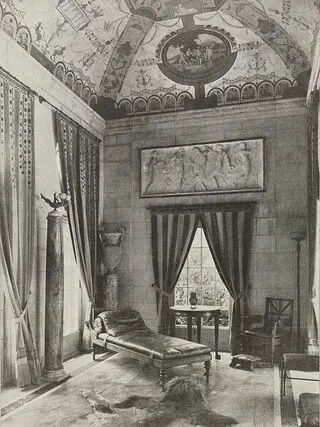
photo by: Kykuit
The stone teahouse at Kykuit was designed by architect William Welles Bosworth, who based the interior decoration on material excavated from the ruins of Pompeii.
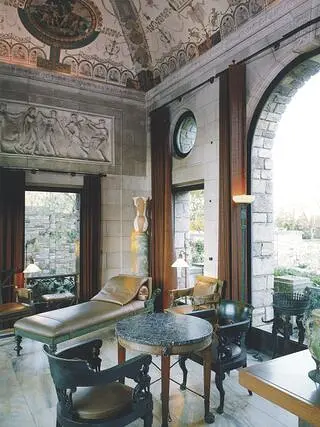
photo by: Kykuit
The chaise lounge in Kykuit’s stone teahouse is made of wood but, like other furnishings in the teahouse, is painted to appear bronze.
The chaise lounge at Kykuit stands in the site's stone teahouse. Like other furnishings in the teahouse, it is wooden and painted bronze. In 1910, William Baumgarten & Co., the makers of the piece, wrote in a letter that, "...the very individual and personal quality of the designs required a great deal of experimental work... Mr. Rockefeller must be so pleased with the result, which we consider the most artistic furniture ever executed in our shop...." The teahouse and its furnishings were used by philanthropist and abolitionist Laura Celestia Spelman Rockefeller, who spent much time in the teahouse and its surrounding gardens during her final years.
Kykuit is a National Trust Historic Site.
President Woodrow Wilson House (Washington, District of Columbia)
The chaise lounge at the President Woodrow Wilson House played a significant role during the former president's final years. In 1919, after President Wilson suffered a stroke, first lady Edith Wilson moved the piece into the White House study to provide the president with a place to rest while he continued to work. In 1924, after President Wilson's death, the chaise lounge was moved to the drawing room in the Wilson House. Today, it serves as a symbol of the former president's declining health and Edith Wilson's care. While the daybed's original upholstery was green, it was reupholstered in 1979 and now features a floral chintz pattern.
The President Woodrow Wilson House is a National Trust Historic Site.
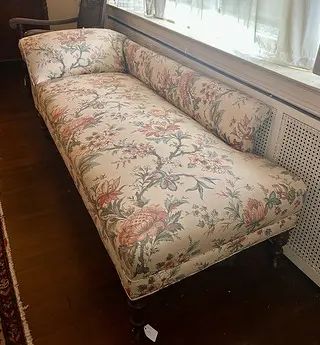
photo by: Woodrow Wilson House
The daybed at the Woodrow Wilson House once lived in the White House, where it provided the ailing president with a place to rest while he worked.
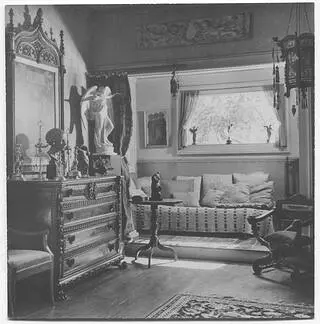
photo by: Chesterwood Archives Chapin Library
Artist Daniel Chester French designed a wooden daybed to furnish his studio in Concord and, later, his studio at Chesterwood.
Chesterwood (Stockbridge, Massachusetts)
Chesterwood features a Pompeian-style wooden daybed created by artist Daniel Chester French for his first studio in Concord, Massachusetts. In an 1879 letter to Ellen Ball, French wrote, "I have fitted up a window seat luxuriously with different colored cushions, curtain & so on, & if you should see it you would want to take an interesting book & stay there." French brought the daybed to his Chesterwood studio and installed it in a nook that functioned as both a relaxing space and a changing area for models, with a curtain nearby that could be drawn for privacy. When Margaret French Cresson inherited Chesterwood, she further embellished the space with additional artwork, furnishings, and lighting. The daybed is still present at Chesterwood, though its original fabric and pillows were replaced during the site's studio restoration in 2014.
Chesterwood is a National Trust Historic Site and a member of the Historic Artists' Homes and Studios Program.
Cliveden (Philadelphia, Pennsylvania)
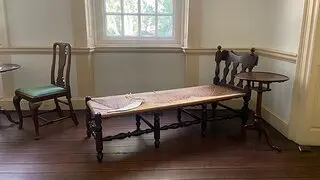
photo by: Cliveden
The daybed at Cliveden features robust turned legs and a rush seat that is typical of those found on furniture from 17th- and 18th-century Pennsylvania.
The daybed at Cliveden is currently on loan from the Chester County History Center in Pennsylvania. Housed in Cliveden's dining room, the daybed's robust turned legs and rush seat are typical of those found on furniture from 17th- and 18th-century Pennsylvania. In the 18th century, while the Chew family lived at Cliveden, the dining room served multiple functions. In addition to dining, it was a space for relaxation and entertainment.
Cliveden is a National Trust Historic Site.
The Edith Farnsworth House (Plano, Illinois)

photo by: Drew Pertl Photography
Visitors and staff at the Edith Farnsworth House named artist Noel Mercado's daybed their favorite piece in his show "en caminos," which was held on site in 2026.
In the 1950s, Dr. Edith Farnsworth furnished her home with a 1952 steel daybed whose designer is unknown but believed to be Harry Weese. In the 1970s, Lord Peter Palumbo, the second owner of the house, furnished it with a Barcelona Couch designed by Lilly Reich and Ludwig Mies van der Rohe, the architect of the house. In 2026, Edith Farnsworth House artist-in-residence Noel Mercado sourced and reupholstered a Barcelona Couch using textiles from his family’s home state in Mexico for his exhibition en caminos, in which he reimagined furnishings at the site. His final artwork pays homage to his family’s history, Mies van der Rohe and Reich’s design, and historical memory.
The Edith Farnsworth House is a National Trust Historic Site.
The Mabel and Victor D'Amico Studio & Archive (Amagansett, New York)
The daybed at the Mabel and Victor D'Amico Studio & Archive is none other than "The Furry Couch." Inspired by "The Fur Lined Teacup," a Surrealist piece by Meret Oppenheim that features a teacup and saucer made of fur, "The Furry Couch" was constructed in the 1950s with a flokati rug made entirely of sheep's wool. The daybed currently rests in the site's glass room.
The Mabel and Victor D'Amico Studio & Archive is a member of the Historic Artists' Homes and Studios Program.
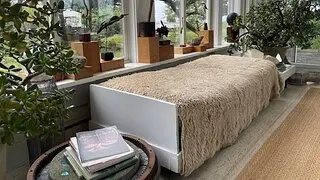
photo by: Mabel & Victor D'Amico Studio and Archive
Crafted from sheep's wool, "The Furry Couch" functions as a daybed at The Mabel and Victor D'Amico Studio & Archive.
Olive Rush Historic Artist Home & Garden (Santa Fe, New Mexico)
Artist Olive Rush's home features a long room that once functioned as a studio, an art gallery, and a living room. The room includes a daybed that once stood across from the fireplace, along with an armchair and rocking chair. Rush favored the rocking chair when conversing with studio visitors, who often sat on the daybed. The historic daybed remains on site.
The Olive Rush Historic Artist Home & Garden is a member of the Historic Artists' Homes and Studios Program.
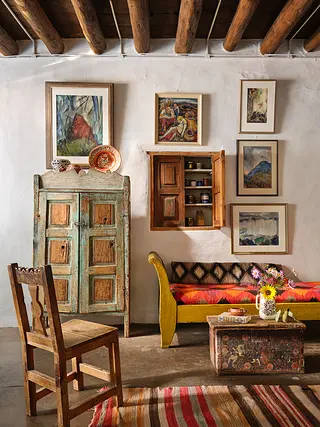
photo by: Wendy McEahern for Parasol Productions
Textiles and artworks surround the daybed at the Olive Rush Historic Artist Home & Garden.
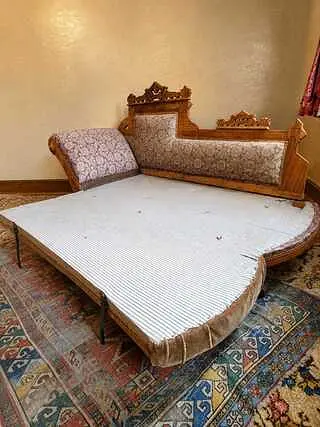
photo by: Hotel de Paris Museum
The chaise lounge at the Hotel de Paris Museum functions as both a fainting couch and a bed, reflecting the Victorian-era trend of creating multipurpose furniture.
Hotel de Paris Museum (Georgetown, Colorado)
The 19th-century chaise lounge at the Hotel de Paris Museum was designed to function as a fainting couch and bed. When opened, the couch provides a larger sleeping surface. Its adaptability reflects the Victorian-era trend of creating furniture and objects that served dual purposes, often for both financial and space-saving reasons. While the designer of this piece is unknown, the scrollwork and decorative cresting carved into the couch's wooden frame are characteristic of the style created and popularized by British architect and designer Charles Eastlake.
Hotel de Paris is a National Trust Historic Site.
The Glass House (New Canaan, Connecticut)
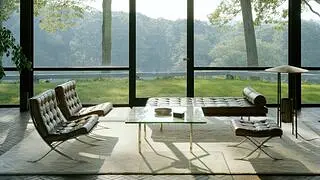
photo by: Eirik Johnson
The Barcelona Couch and Chairs seen in the living room of The Glass House were designed by Ludwig Mies van der Rohe and Lilly Reich.
Philip Johnson, the architect who designed and lived in The Glass House, filled his home with furniture designed by his friend and fellow architect, Ludwig Mies van der Rohe. In the living room stands a 1930 prototype of Mies van der Rohe and Lilly Reich’s Barcelona Couch, the same piece seen at the Edith Farnsworth House. Mies van der Rohe designed this prototype specifically for Johnson. The two Barcelona Chairs nearby date to 1929, when Mies van der Rohe designed them for the Barcelona Pavilion at the International Exposition in Barcelona, Spain. The precise layout of the living room, with its fixed arrangement of Johnson's furniture, was designed to contrast with the ever-changing outdoor landscape that surrounds the space.
The Glass House is a National Trust Historic Site.
Save Historic Places That Tell Our Full American Story
When you join the National Trust, you help save historic and culturally significant places nationwide.