Consider This: A Closer Look at Mexican Modernist Design at the Edith Farnsworth House
In the United States, Modernist design is often described as being of a clean, simple aesthetic—and where the line between the natural and built environment blurs. Nowhere is this more evident than at the Edith Farnsworth House, a National Trust Historic Site in Plano, Illinois.

photo by: Farnsworth House
The Edith Farnsworth House in Plano, Illinois.
But how did Modernist design evolve across borders? In 2026, Farnsworth Forward, a two-year initiative highlighting the relationship of the house to international modernist movements, focused on Mexican Modernism. Fertile Ground: Crossroads of Design in Mid-Century Mexico 1930s-1970s—the final installation of a three-part series and based on the curatorial vision of Ana Elena Mallet—explores how Mexican Modernism was an intentional construction where “architecture and design became central tools for imagining and organizing modern public and private life.”
One element of the show is a reinterpretation of the Edith Farnsworth House where chairs, tables, and other household objects from Mexico were placed throughout the house. Their location in the space prompts visitors to consider how these pieces are in conversation not only with the Ludwig Mies van der Rohe-designed site, but also the furniture and objects brought into the home by Edith Farnsworth and the house’s second owner Lord Peter Palumbo.
Take a tour with us as we explore some of the objects in Fertile Ground and their counterparts at the Edith Farnsworth House.
.webp)
photo by: Hedrich-Blessing
The living area of the Edith Farnsworth House in 1951.
Living
When Dr. Edith Farnsworth first moved into the glass house during the 1950s, she chose to decorate in her own Modernist style and not use the furniture that Mies van der Rohe had planned to be displayed in the house.
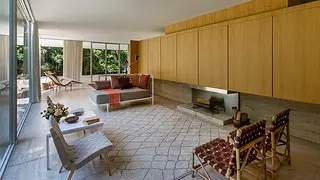
photo by: William Zbaren
The living area at the Edith Farnsworth House during “Edith Farnsworth Reconsidered.”
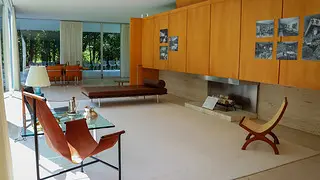
photo by: Erin Law
The living area at the Edith Farnsworth House during “Fertile Ground.”
Featured in the first image is the house as it looked during the 2020-21 exhibition, Edith Farnsworth Reconsidered, which included copies of furnishings that Farnsworth originally had in her home, including a chair designed by Jens Risom. The second image shows how the house is staged for Fertile Ground, where a Butaque chair by Clara Porset has been swapped in.
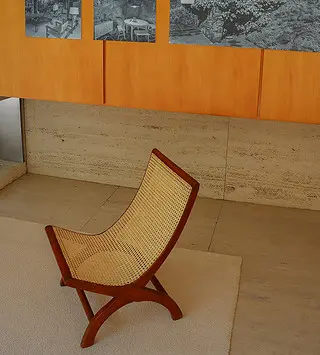
photo by: Erin Law
A close-up view of Clara Porset’s Butaque chair.
.webp)
photo by: Hedrich-Blessing
A close-up view of the Jens Risom lounge chairs c. 1951.
For Clara Porset, the Butaque offered a way to build modern design out of Mexico's own material culture. Low and curved, with roots in both pre-Columbian and Spanish furniture, the Butaque embodied the hybrid character of Mexican material culture and had taken on many regional forms adapted to local climates and materials.
In contrast, the Jens Risom chairs were originally made with surplus parachute straps from World War II. The ones featured here are made of maple wood and woven cotton-blend straps.
Consider how the Jens Risom lounge chairs, selected by Farnsworth, work within the space as compared to Clara Porset’s Butaque chair featured in the exhibition. How do the different materials play off the other pieces in the living area?
Stay connected with us via email. Sign up today.
Lighting
Unlike many homes today, the house does not have overhead lighting, making lamps an essential part of the home’s decor. In this case, Farnsworth chose a Triennale floor lamp designed by Angelo Lelli, while Fertile Ground features Feli Tissot’s Fantasy lamp.
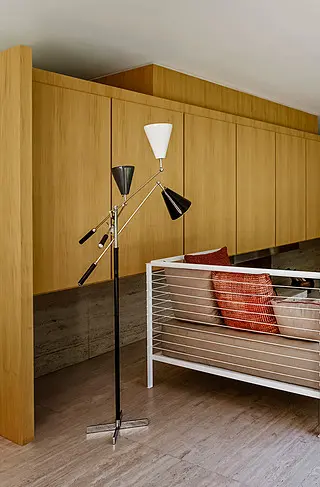
photo by: William Zbaren
The Triennale lamp in the living area of the Edith Farnsworth House.
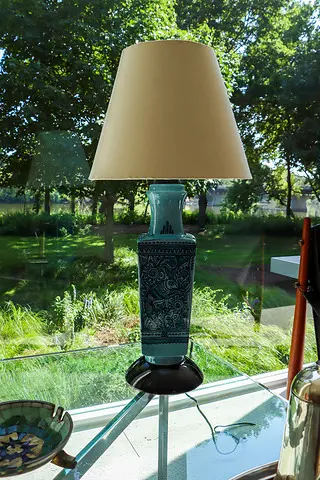
photo by: Erin Law
The Fantasy lamp sits on a glass table in the living area of the Edith Farnsworth House.
During the mid-20th century, Taxco, Mexico, became a laboratory where craft, modern design, tourism, and international exchange met. French-born Felix Tissot found in Taxco grounds for experiment, extending its material vocabulary with ceramic lamps and objects. The Fantasy lamp is made of hand-painted ceramic.
Take a closer look at the Lelli Triennale floor lamp. How are the shape and style different from the Tissot lamp? This Three-Arm floor lamp was designed c. 1947 and was made in Italy. Over the years, these popular floor lamps were made in a wide variety of finishes and options. Edith Farnsworth’s lamp had a tripod base which made it prone to falling over, a quad base (and later a stone base) were offered to reduce tipping.
Consider how a lighting feature can change the energy in a room. How might a table lamp and a standing lamp cast shade in a different way and interact with the open feeling of the house? How do the different lamp styles speak to each other?
Dining
The kitchen and dining area of a home are often considered the heart or emotional center of the house. These three images show different interpretations of the dining area at the Edith Farnsworth House.
Mies van der Rohe’s MR Chair, with its cantilever frame and steel tubing, has been associated with the house since opening to the public in 2004, but Fertile Ground adds chairs by Diego Matthai and Michael van Beuren.
Matthai’s México chair was designed in 1970 and is a modern interpretation of the traditional silla de palo (a chair made of wood and woven elements) and is made of chromed metal shifting the more natural style of the original design into one that is more industrial and urban.
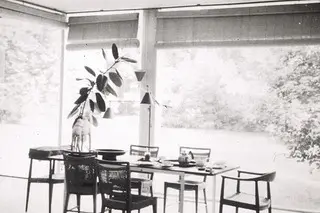
photo by: Edith Farnsworth House
A historic image of the dining area at the Edith Farnsworth House.
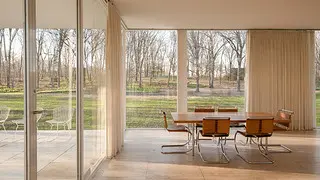
photo by: Open Space Series
The dining area at the Edith Farnsworth House during “Edith Farnsworth Reconsidered.”
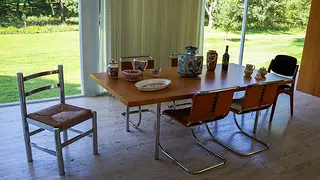
photo by: Erin Law
The dining table at the Edith Farnsworth House with chairs designed by Mies van der Rohe, Diego Matthai and Michael van Beuren.
Michael van Beuren studied under Mies van der Rohe at the Bauhaus but chose to live and design in Mexico once the school was closed. His chair from the Danish line shows the connection to the International Style and is most like how Farnsworth had the dining table set. More industrial in style (standardized components for machine production), the chairs show two aspects of Mexican Modernity, one through local form, the other through industry and access.
Consider how these three chairs work together at the table. How are the materials different? How are they the same?
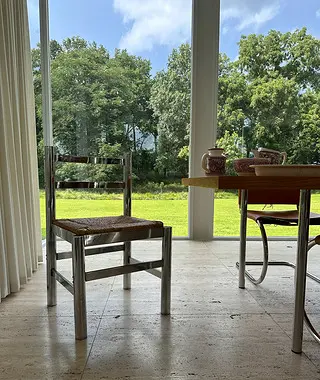
photo by: Edith Farnsworth House
A closer view of the Matthai México chair.
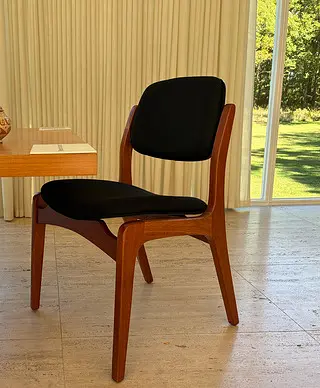
photo by: Edith Farnsworth House
A closer look at the van Beuren Danish line chair.
Relaxing
Relaxation is an important component to a house, and these images represent how Farnsworth and Palumbo chose to lounge in their glass house and enjoy the views of nature. Edith’s Model 36 Chaise Lounge and Vitol Easy Chair and Leg Rest were made and designed in Sweden. Originally made of laminated beech wood with woven hemp straps, they were a place to read, nap, or listen to music.
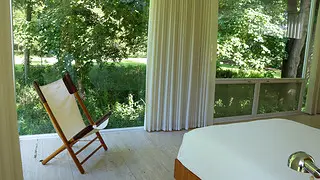
photo by: Erin Law
The Tulum chair in the sleeping area of the Edith Farnsworth House.
Palumbo’s MR Chaise Lounge was originally designed by Mies van der Rohe in 1927. He was inspired by the work of his fellow Bauhaus designer, Marcel Breuer, who is often credited with being the pioneer in designing chairs with curved steel frames. The MR Chaise Adjustable Lounge removes the harsh angles of many cantilevered chairs and adds curves, which also helps with not stretching out the material.
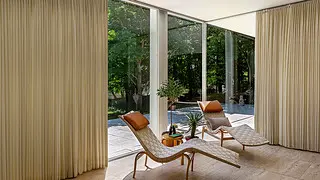
photo by: William Zbaren
Two of the Bruno Mathsson Model 36 Lounge chairs in the corner of the Edith Farnsworth House.
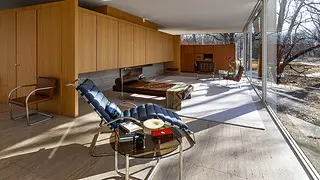
photo by: William Zbaren
The MR Chaise Adjustable Lounge preferred by Lord Peter Palumbo.
Fertile Ground includes various chairs made for relaxing, including Po Shun Leong’s Tulum chair set in the corner to include views of the Fox River and the yard behind the house. The Chinese British designer was inspired by the rural landscapes and craft traditions of Mexico. This chair, made of wood and canvas, ties body, climate, and landscape together.
Consider how the different materials promote leisure? Which of these these seats are you drawn to? What can you tell about the inspiration behind each of these chairs?
Fertile Ground was organized by Museo Universitario Arte Contemporaneo MUAC, Mexico City in collaboration with the Edith Farnsworth House. It closes November 22, 2026. Descriptions of each object are pulled from the exhibit labels for Fertile Ground and Edith Farnsworth Reconsidered.
Save Historic Places That Tell Our Full American Story
When you join the National Trust, you help save historic and culturally significant places nationwide.
Priya Chhaya is the associate director of content at the National Trust for Historic Preservation,
Kristin Lochner is the associate manager for marketing and events at the Edith Farnsworth House.