How 5 Historic Congregations are Recovering After Emergencies
Houses of worship are one of the most common places people turn in times of crisis. But what happens when the buildings themselves are threatened by an unanticipated emergency? That is exactly what the Intervention Fund, an emergency grant program under the umbrella of the National Fund for Sacred Places, aims to address. A program of Partners for Sacred Places in collaboration with the National Trust for Historic Preservation, the Intervention Fund supports congregations with urgent repair needs stemming from an emergency, allowing them to safely return to serving their communities.
Since 2019, over $1 million in grants have allowed 23 congregations to not only respond to their immediate needs, but also ensure the long-term preservation and community use of their buildings. After receiving a grant for stained-glass window repairs, R. Keith McDonald, trustee at Second Baptist Church of Los Angeles, shared that “the congregation and community immediately noticed the difference, as these windows had been covered with cardboard. There is a renewed spirit . . . to reimagine [our] programs to better suit the needs of the community.”
Learn about five historic congregations that have received assistance from the Intervention Fund.
The Cathedral of All Souls (Asheville, North Carolina)
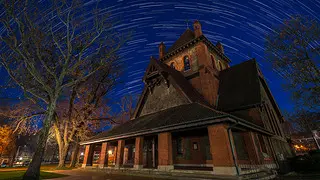
photo by: Ken Lane/@carshowshooter via Flickr CC BY-NC-SA 2.0
Exterior of the Cathedral of All Souls in December 2014.
The Cathedral of All Souls is the largest structure in Biltmore Village and the only remaining church designed by notable architect Richard Morris Hunt. Completed in 1896, the Romanesque Revival-style church features Gothic arches, heavy timber beams, and stained-glass windows designed by Maitland and Helen Armstrong. With a long history of service to the community, All Souls has helped establish early area schools, a hospital, the region’s first gay and lesbian advocacy group, and an affordable mental health counseling center.
When Hurricane Helene hit Asheville in September 2024, the Cathedral of All Souls flooded for the first time in its 129-year history, with more than four feet of water and mud covering the floors and walls. The entire church campus was impacted, with immediate cleanup costs alone costing well over $1 million. An Intervention Fund grant of $100,000 is helping support the planning work needed to restore this significant structure.
Second Baptist Church of Los Angeles (Los Angeles, California)
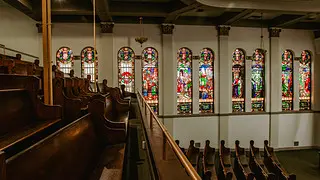
photo by: Vivian Chan
Interior of the Second Baptist Church of Los Angeles.
Since 1885, Second Baptist Church has welcomed countless influential Black leaders. The Mediterranean Revival building, designed by Black architects Paul Revere Williams and Norman Marsh, was completed in 1926 by an all-Black construction company. Seating up to 2,500 people, the church was the largest meeting space owned by African Americans in the western United States before World War II. The church played a role in mentoring a young Dr. Martin Luther King, Jr and was considered his “West Coast home.” The church has hosted speakers including W.E.B. DuBois, Paul Robeson, and Mary McLeod Bethune.
In the summer of 2021, the Los Angeles Police Department unsuccessfully attempted to detonate illegal fireworks in the heart of a residential neighborhood. The resulting explosion injured seventeen people, destroyed numerous homes and vehicles, and cracked Second Baptist’s original stained-glass windows. Despite a $21 million settlement paid to the community’s victims, the church only received $5,000. An Intervention Fund grant of $46,797 helped the church restore eight of the damaged windows.
Second Baptist Church has also been awarded two grants from the National Trust's African American Cultural Heritage Action Fund to support the development of a historic structures report and a capital projects grant from its Preserving Black Churches program in 2022.
Congregation K’nesseth Israel (Baytown, Texas)
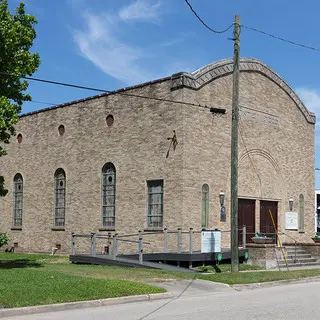
photo by: Emily Rena Williams
Exterior of Congregation K'nesseth Israel.
.webp)
photo by: Joan Linares
Congregation K’nesseth Israel following Hurricane Beryl in 2024.
Congregation K’nesseth Israel formed in the 1920s, as the area’s population grew after the discovery of oil in Goose Creek (present-day Baytown). The synagogue was completed in 1930 in the Byzantine Revival style by Houston-based Jewish architect Lenard Gabert. After World War II, the Jewish population migrated to larger urban areas, and many synagogues closed across the state. However, Congregation K’nesseth Israel has remained both a tangible marker of Jewish history and ongoing hub of modern Jewish life. Despite being without a rabbi since 1953, the congregation has continued to hold lay-led services.
When Hurricane Beryl hit in July 2024, it was the third major hurricane to damage the synagogue since 2008. High winds ripped the bricks off the front facade of the synagogue. An Intervention Fund grant of $73,473 is helping Congregation K’nesseth Israel restore the front facade, supporting the preservation of one of few “small town” synagogues remaining in Texas.
Congregation K'nesseth Israel was also a case study participant in 2021 for the Disaster-Proof Texas Heritage research project with Partners for Sacred Places and the University of Texas at San Antonio Center for Cultural Sustainability
Trinity United Methodist Church (Montpelier, Vermont)
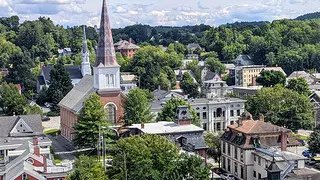
photo by: Jay Voorhees
Aerial view of Trinity United Methodist Church.
For more than 150 years, Trinity United Methodist Church has stood as a pillar on Montpelier’s Main Street. Completed in 1874 in the Romanesque and Italianate styles, the church features carpentry work by George Guernsey, who later became Vermont’s leading architect and the third mayor of Montpelier.
In July 2023, the region experienced catastrophic flooding, inundating the entirety of downtown Montpelier. The church basement took on over 8 feet of water, which destroyed the boilers, air filtration system, and main electrical panels. Prior to the floods, area churches each hosted community lunches on different days of the week. After the floods, these critical food programs were at risk of being discontinued due to damage to the area’s churches.
An Intervention Fund grant of $50,000 helped Trinity UMC relocate its main electrical panels upstairs and restore power to the building. This allowed the church to become the host of the community lunch program four days a week. Trinity and three other churches have since formed a 501(c)(3) to formalize their partnership and ensure the program continues into the future.
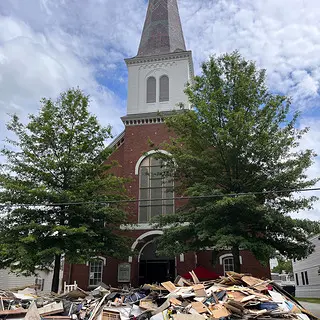
photo by: Trinity UMC
Exterior of Trinity UMC following a historic flood in July 2023.
St. Philip’s Evangelical Lutheran Church (St. Louis, Missouri)
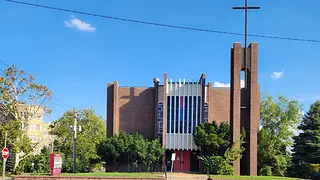
photo by: Rev. Richard E. Ashley
Exterior of St. Philip’s Evangelical Lutheran Church.
Built in 1966, St. Philip’s Evangelical Lutheran Church is located in The Ville neighborhood, St. Louis’s historic center of Black culture. The mid-century modern structure was designed by Charles E. Fleming, who was the first African American to graduate from Washington University’s architecture program and established the first Black-owned architecture firm in Missouri. The congregation partners with local organizations including the Urban League on a weekly meal and The Empowerment Network on supporting Black men battling prostate cancer.
In May 2025, a powerful tornado hit St. Louis, causing over $1 billion in property damage and impacting almost 5,000 buildings. St. Philip’s served as a hub for relief efforts, distributing supplies to over 300 families and three churches. After the tornado, the roof began leaking extensively, causing significant water damage inside the building.
The insurance company denied their claim, but also required the roof to be replaced to keep their insurance policy. An Intervention Fund grant of $100,000 will help the church replace the roof, repair interior damage, and complete a building conditions assessment to identify any additional damage and plan for long-term preservation of the building.
The Intervention Fund grant continues the National Trust’s ongoing investment in The Ville. In 2021, the Action Fund awarded 4theVille an organizational capacity grant as part of its National Grant Program.
Save Historic Places That Tell Our Full American Story
When you join the National Trust, you help save historic and culturally significant places nationwide.