Indian Creek Bridge/Bertram Bridge
A community-submitted Section 106 success story in Linn County, Iowa.
The Indian Creek Bridge (also known as the Bertram Bridge) is a short-span wrought-iron through truss bridge located in southern Linn County, about one mile east of Cedar Rapids. It was built by the Wrought Iron Bridge Company (WIBCo) of Canton, Ohio, likely after the company patented its distinctive truss design in 1876. The bridge uses an unusual variation of the Pratt truss, featuring double-intersecting counter members that radiate from the center of the span. This configuration, sometimes described as a double-intersection Pratt or Whipple truss, was one of several experimental designs promoted by WIBCo in the late 19th century. Similar designs were used on the Upper Paris Bridge in Linn County (1879) and the Mead Bridge in Butler County (1878).
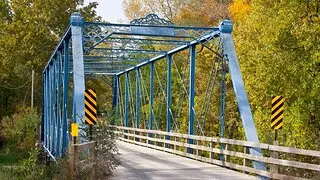
photo by: ArtisticAbode via Wikimedia (CC by 3.0)
The Indian Creek Bridge was placed on the National Register of Historic Places in 1998.
Founded in 1864, WIBCo became one of the most influential bridge manufacturers in the Midwest and was especially active in Iowa during the 1870s. Under the leadership of inventor and company president David Hammond, WIBCo supplied bridges to counties throughout the state during a period of rapid rural road and bridge construction. By 1885, the company had installed bridges in 74 of Iowa's 99 counties, with particularly strong representation in eastern Iowa. The Indian Creek Bridge reflects WIBCo's willingness to experiment with innovative truss designs beyond its more common bowstring and Pratt truss bridges.
The structure retains much of its historic integrity, including its wrought-iron superstructure, timber approach spans, and stone-and-timber substructure. Having undergone no major alterations, it continues to carry limited vehicular traffic today. Because of its rarity, excellent preservation, and association with one of Iowa's most important 19th-century bridge builders, the Indian Creek Bridge is considered a significant example of an uncommon early wagon-truss design and an important artifact of Iowa's transportation history.
The Linn County Secondary Road Department issued a permit for the demolition of the bridge so that it could build a modern bridge capable of handling modern traffic patterns.
What Would Have Been Lost
Without Section 106, local consultation would not have taken place, and the community would have been left with an interpretive panel instead of the opportunity to preserve this historic bridge by integrating it into a nearby trail system. By consulting with interested parties, the historic Indian Creek Bridge was relocated to a nearby nature center, where it is still in use today.
During the spring of 2021, the Linn County Historic Preservation Commission (HPC) was presented with a Memorandum of Agreement (MOA) to compensate the community for federal funds being used to remove the Indian Creek Bridge. The original agreement included interpretive signage in the original location. However, commission members requested an investigation into whether it could be moved.
On August 19, the consulting parties met to explore alternatives. During that meeting, a new MOA was described, which included interpretive signage and relocating the bridge to a depressed area along the Indian Creek Nature Center trail system. At one point during the move, the project appeared to have failed when the bridge collapsed into the creek. However, the local engineering firm worked to find a solution. In the end, all but a small section of the bridge was able to be relocated on the Indian Creek Nature Center trail system. This was an incredible success and a testament to how effective collaboration between governing bodies and consulting parties can be in creating a better-than-expected outcome.
Submitted via the Preservation Action. Visit Section 106 Under Threat for more success stories, information, and to take action.