U.S. Pavilion and Confluence Theater in Hemisfair Park
A community-submitted Section 106 success story in San Antonio, Texas.
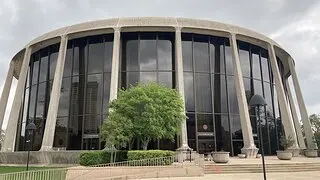
photo by: Toohool (Wikimedia Commons)
The John H. Wood Jr. Federal Courthouse, originally the Confluence Theater, is currently being adaptively reused once again, this time as an event venue.
Hemisfair '68 in San Antonio was the only World's Fair of the 1960s held in the South, and the only one ever hosted by a city in Texas. The federal government invested in constructing two permanent fair buildings, each reflecting innovative midcentury designs, to serve citizens beyond the fair's six-month run. The U.S. Pavilion was designed with precast concrete and a concave front facade to complement the larger, drum-shaped Confluence Theater. The latter, designed by Marmon and Mok Associates, featured travertine limestone panels on the exterior and once housed the largest curvilinear viewing screen in the world.
After the fair ended, the fairgrounds became a public park with the federal buildings being repurposed in the early 1970s. The pavilion became the Adrian A. Spears Judicial Training Center while Marmon and Mok transformed the interior of the theater into the four-story John H. Wood Jr. Courthouse. In 2015, plans were made to relocate the federal court to a new facility. In 2016, the courthouse was included on Preservation Texas’ list of Most Endangered Places for 2016.
The pending sale of the vacated property by the General Services Administration (GSA) to the City of San Antonio triggered Section 106. As part of the process, the GSA hosted public meetings and invited written comment from the citizens of San Antonio. Members of local tribes attended, and the Conservation Society of San Antonio, a longstanding preservation advocacy group, was among the local organizations invited to become a consulting party.
The Texas Historical Commission, which serves as Texas State Historic Preservation Office (SHPO), and stakeholders were engaged in the negotiation of the preservation covenant terms, including the period of significance considerations that focused on the World's Fair rather than the federal courthouse uses, which increased the site's flexibility for future rehabilitation. The GSA's creativity in allowing renovation, restoration, and rehabilitation zones put the City of San Antonio at ease so that they could see potential for modifying interior spaces for future endeavors.
What Would Have Been Lost
Without Section 106, the federal government could have excluded local citizens from decisions made about the U.S. Pavilion and Confluence Theater in Hemisfair Park, a project closely connected to the city's heritage. If these sites had not been protected, Hemisfair Park would have lost the third of its five original structures that stood at the World's Fair in San Antonio in 1968. Input from stakeholders and local San Antonians ultimately resulted in preservation covenants being placed on these two endangered sites. The Confluence Theater is now on a path toward renovation as an event venue in the sports and entertainment district the city is planning.
As a result, the GSA placed preservation covenants on the buildings prior to transferring them to the City. The covenants allow for renovation changes, but not demolition, and the city has revised redevelopment plans for Hemisfair Park to include repurposing the buildings. Section 106 provided the means for local citizens to speak directly to representatives of the federal government prior to the City’s acquisition, giving concerned taxpayers a voice in shaping the GSA’s agreement with the City.