Howard-Ralston Eucalyptus Tree Rows
A community-submitted Section 106 success story in Burlingame, California.
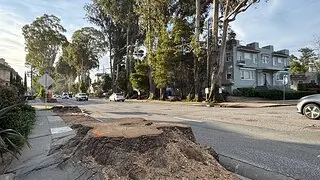
photo by: Burlingame Historical Society
A number of historic trees lining El Camino Real were removed due to a state highway improvement project.
Planted by famed landscape gardener John McLaren for property owners George H. Howard and William C. Ralston in the mid-1870s, the Howard-Ralston Eucalyptus Tree Rows are associated with the founding of the cities of Burlingame and Hillsborough, California. The Tree Rows directly influenced Burlingame’s first laws, most notably zoning and beautification ordinances specifically crafted to protect the trees from destruction due to development. For well over a century, citizens (including elected officials) engaged in well-documented activism to preserve them for future generations. In 2012, the cultural landscape was added to the National Register of Historic Places.
Nearly two decades ago, the California Department of Transportation (Caltrans), the state agency that owns the highway, proposed a major highway widening project for turn-channels that would have resulted in the removal of protected trees with no replacements due to lack of space. This controversy triggered a much broader debate about the long-term viability and degradation of the highway, utility lines, drainage, sidewalks, and Americans with Disabilities Act (ADA) compliance, all of which are literally intertwined with the enormous trees and their roots.
What Would Have Been Lost
Lack of Section 106 consultation would have undone 120 years of community activism associated with saving the Howard-Ralston Eucalyptus Tree Rows. The tree-lined highway could have been stripped of its signature trees and left devoid of historical context. Because of the required Section 106 consultation process, stakeholders and the local community were successfully able to mitigate the project’s damage to the site’s trees.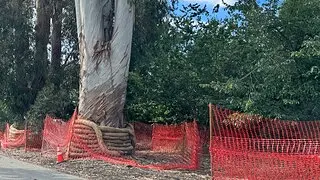
photo by: Burlingame Historical Society
While some trees lining El Camino Real have been removed, others are being protected under damage mitigation agreements reached through the Section 106 consultation process.
Section 106 was crucial during the planning of this major infrastructure project, which ultimately included 2.2 miles of tree-lined highway (El Camino Real) through Burlingame, California. The community relied heavily on the public process to get an accurate assessment of inevitable damage to the trees by Caltrans, and to hold informational and stakeholder meetings on a regular basis to discuss realistic, attainable mitigation. The stated goal became: Retain the character and health of the historic trees and improve the safety of the roadway and sidewalks. Everyone worked together on this project to move it forward.
The project started in January 2026. When completed in late 2029, everyone who was encouraged and invited to participate in the process will be proud to have taken part in something that would not have been possible without Section 106.
Jennifer Pfaff is a longtime Burlingame resident and president of the Burlingame Historical Society, as well as being a current Burlingame Planning commissioner. Her primary focus has been on tree preservation and the improvement of the urban tree canopy.
Visit Section 106 Under Threat for more success stories, information, and to take action.